
A fresh interpretation of Victor Hugo’s legendary character arrives on Netflix, bringing together historical drama, romance and the turbulent streets of nineteenth-century Paris.
Few literary characters have remained as recognisable across generations as Quasimodo, the central figure of Victor Hugo’s celebrated novel The Hunchback of Notre-Dame. Now, Netflix is preparing to revisit the famous character with a new French historical drama, Quasimodo, the Soul of Paris, offering audiences a different perspective on the story behind the literary legend.
Directed by Jean-François Richet and starring acclaimed French actor Vincent Cassel in the title role, the film is scheduled to arrive on Netflix on 27 November 2026.
Rather than delivering a conventional adaptation of Hugo’s original novel, the production takes an intriguing historical approach, imagining the possible real-life inspiration behind one of literature’s most enduring characters.
A Different Perspective on a Familiar Story
Set in Paris in 1830, during the reign of Charles X, the film takes place against a backdrop of political unrest, social divisions and the growing threat of a cholera epidemic.
The story follows a hunchbacked stonemason working at Notre-Dame Cathedral, a man regarded with suspicion and mistaken for a monster by those around him.
As the city struggles with disease, he becomes a potential key to finding a medical cure, bringing him into conflict with the authorities.
At the centre of the emotional narrative is Agnès, a dancer with whom Quasimodo falls in love. As the political situation deteriorates, he attempts to protect her, with the cathedral becoming a place of refuge amid the surrounding chaos.
The film therefore moves beyond the familiar image of Quasimodo as simply the isolated bell-ringer of Notre-Dame, exploring themes of prejudice, compassion, identity, love and the treatment of people considered different by society.
The Historical Possibility Behind the Legend
One of the most interesting aspects of the production is its inspiration.
Netflix explains that the screenplay draws on the memoirs of English sculptor Henry Sibson, which refer to a hunchbacked stonemason working at Notre-Dame during the 1820s.
This historical reference provides the foundation for the film’s central hypothesis: that Victor Hugo may have encountered such a man while researching his work.
It is important to distinguish this imaginative interpretation from established historical fact. There is no confirmed evidence that this individual directly inspired Hugo’s character. Instead, the film uses the historical possibility as a starting point for a fictional exploration of how a real individual might have influenced a celebrated literary creation.
By connecting the worlds of The Hunchback of Notre-Dame and Les Misérables, the production also places Hugo’s literary legacy within the wider social and political circumstances of nineteenth-century France.
Vincent Cassel Leads an Impressive Cast
Taking on the challenging title role is Vincent Cassel, whose transformation into Quasimodo required considerable preparation.
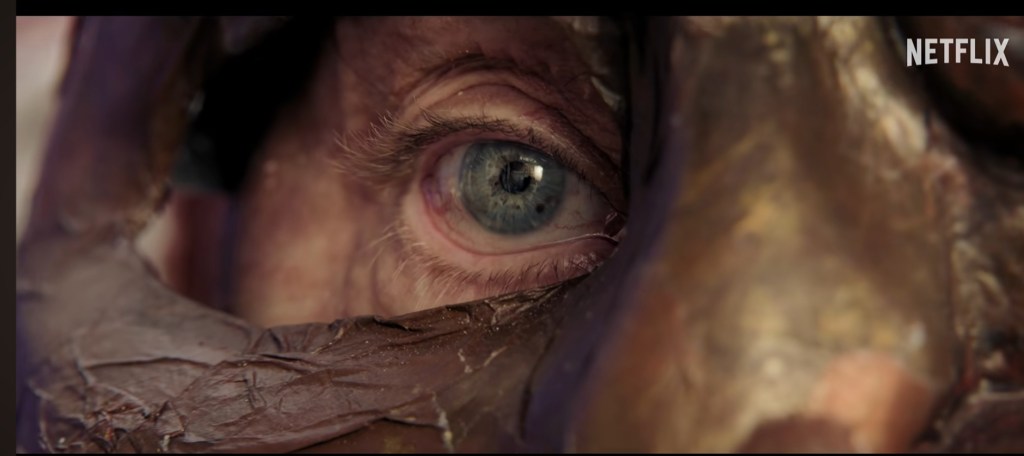
According to Netflix, the actor spent approximately three and a half hours in makeup each day. The process involved specially created silicone masks, carefully painted to resemble natural skin, alongside padding concealed beneath his costume.
Around 40 individual masks were produced for the filming, with intricate details including the beard and eyebrows created through painstaking handwork.
Cassel is joined by Daphné Patakia as Agnès, Karim Leklou as Coco-Lacour and Benjamin Voisin as experimental doctor Gaspard Tournier de Vaillac. Noémie Lvovsky also features in the cast.
Together, the performers bring to life a collection of characters navigating a city experiencing enormous social and political uncertainty.
Recreating Nineteenth-Century Paris
Another particularly impressive element is the scale of the production’s historical recreation.
Notre-Dame Cathedral occupies a central position in the story, although the film portrays it as an abandoned building threatened with dismantling rather than the celebrated landmark familiar to modern visitors.
Interior cathedral scenes were filmed at Bourges Cathedral, which was cleared of its furniture to accommodate the production.
The filmmakers also recreated historic Parisian neighbourhoods, including Les Halles and La Grande Roquette, using locations in Senlis and Compiègne alongside specially constructed sets.
The attention to detail extended to the costumes and scenery. The production created 117 costumes and rented a further 800, while the recreation of the Paris catacombs required an extraordinary 9,000 skeletons and 8,000 skulls.
These details demonstrate the considerable work involved in bringing the atmosphere and appearance of nineteenth-century Paris to the screen.
A Story With Contemporary Relevance
Although rooted in the past, the themes explored in Quasimodo, the Soul of Paris remain relevant.
The treatment of people who appear different, the relationship between social status and power, the consequences of prejudice and the ethical responsibilities surrounding medical research are subjects that continue to generate discussion today.
Quasimodo has traditionally represented the struggle between outward appearance and inner humanity. This new interpretation appears to build on that idea while placing it within a wider examination of society, inequality and human relationships.
It also offers an opportunity to reconsider Victor Hugo’s literary legacy and the remarkable ability of classic characters to be reinterpreted for new generations.
A New Chapter for a Literary Classic
Reimagining an established literary character is never without its challenges, particularly when the original story has become so deeply embedded in popular culture.
However, Quasimodo, the Soul of Paris appears to offer something more than another straightforward retelling. By combining a historical hypothesis with an original dramatic narrative, Netflix is approaching the familiar legend from a different direction.
With Jean-François Richet directing, Vincent Cassel leading the cast and considerable attention given to historical atmosphere and production design, the film is an intriguing addition to Netflix’s international film offering.
For admirers of classic literature, French cinema and historical storytelling, this is certainly a production worth keeping an eye on.
Quasimodo, the Soul of Paris arrives on Netflix on 27 November 2026.





Leave a Reply