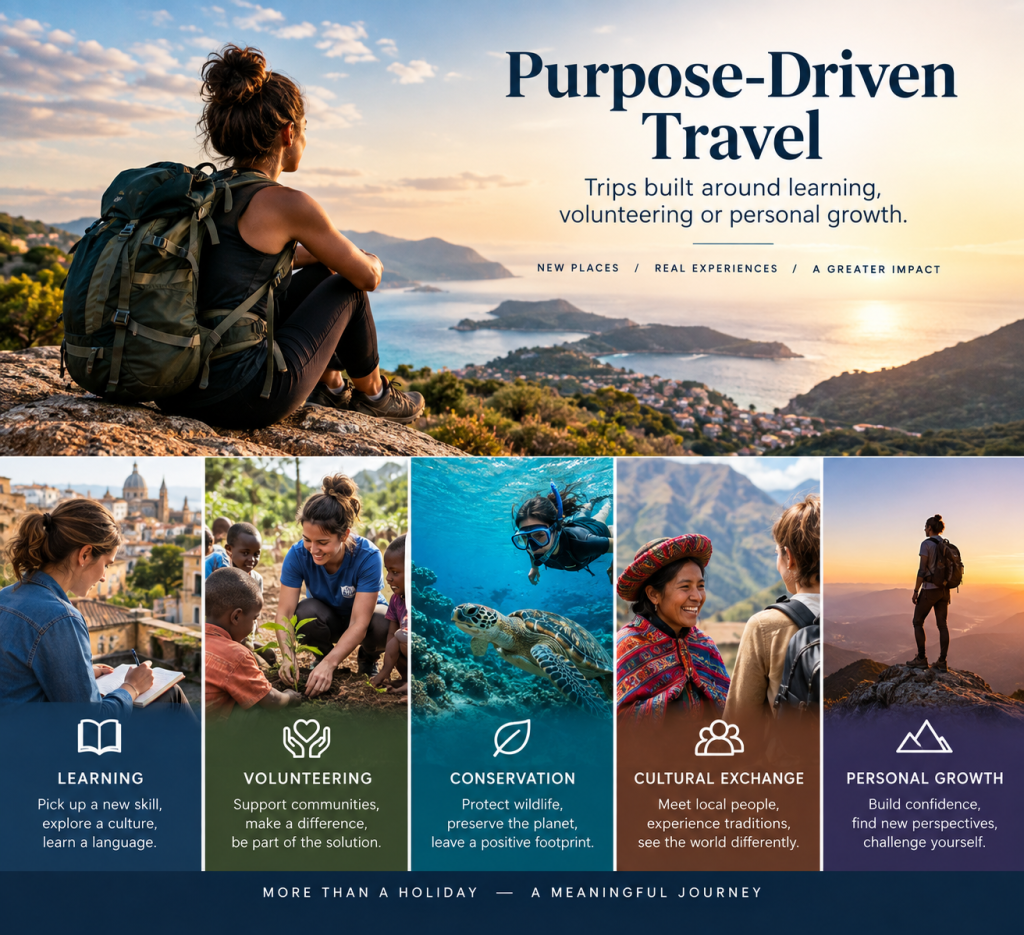
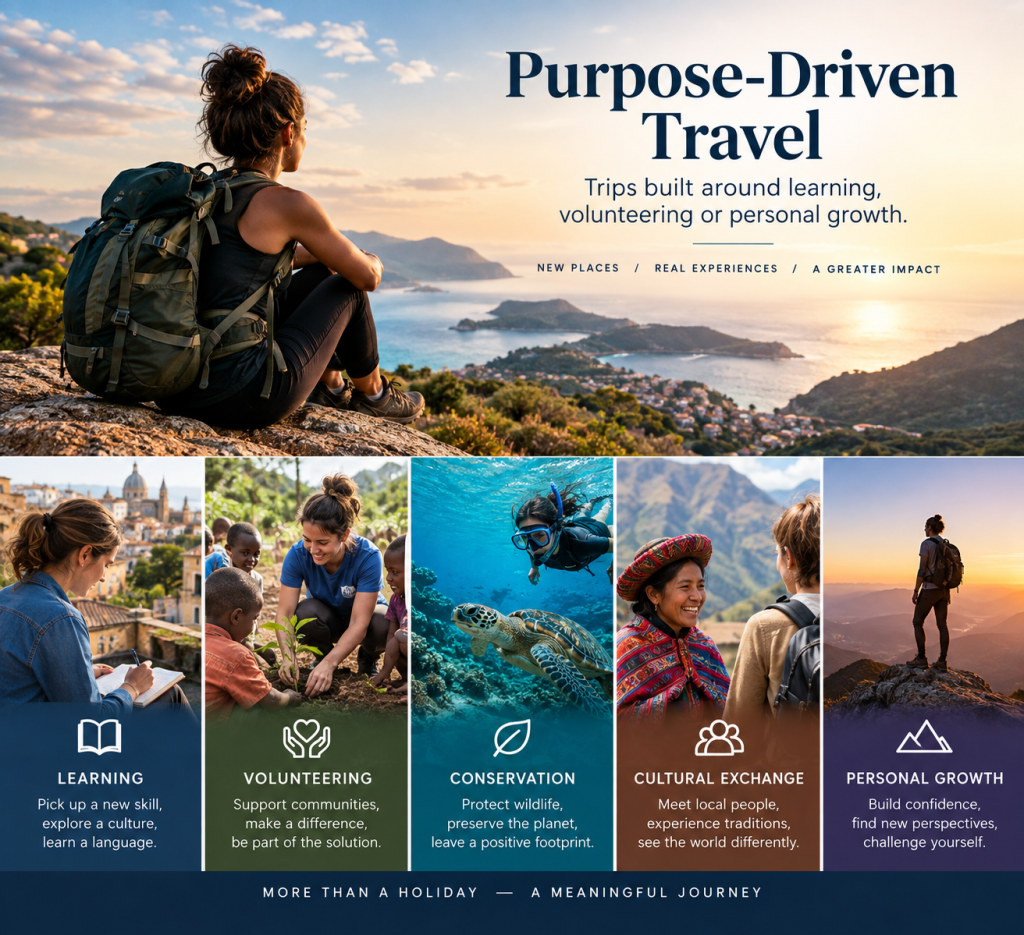
Travel has traditionally been associated with relaxation, sightseeing and escaping from everyday routines. But a growing area of the travel industry is placing greater emphasis on what people can learn, contribute and take away from an experience.
Known as purpose-driven travel, this approach involves planning trips around activities such as education, volunteering, cultural exchange, environmental conservation, personal development or learning new skills.
Rather than simply asking where to go, purpose-driven travellers may begin by asking a different question: What do I want to learn, experience or contribute?
Learning Through Travel
Travel has long provided an informal form of education, allowing people to experience history, languages, food, architecture and traditions outside a classroom.
Purpose-driven travel takes this idea further by making learning one of the central reasons for a trip.
A traveller might visit Spain specifically to study Spanish, spend time in Italy learning traditional cooking, explore archaeological sites with an educational programme, or travel to China to experience Mandarin and Chinese culture.
Language learning is particularly suited to this type of travel because being surrounded by native speakers can provide opportunities to practise communication in everyday situations.
Other educational trips can focus on subjects such as photography, wildlife, history, art, music, conservation or traditional crafts.
Volunteering Abroad
Volunteering is another important part of purpose-driven travel. Volunteer programmes can involve environmental conservation, community projects, wildlife protection, education and disaster-recovery support.
However, responsible volunteering requires careful consideration.
Travellers should research organisations before committing to a programme, including how projects are funded, who manages them and whether local communities are directly involved in deciding what assistance is needed.
The United Nations has emphasised the importance of sustainable development and partnerships that support communities rather than creating unnecessary dependency.
Responsible volunteering therefore means considering not only what a traveller wants to contribute, but also whether the activity is genuinely useful to the people or environment involved.
Environmental Travel
Environmental conservation has also become an important reason for travelling.
Trips can be organised around activities such as habitat restoration, marine conservation, wildlife monitoring, reforestation and environmental education.
Some travellers choose destinations specifically because they want to understand ecosystems and conservation challenges first-hand.
This can turn a conventional holiday into an educational experience while also encouraging visitors to think more carefully about their environmental impact.
Travellers can contribute by choosing locally owned accommodation and businesses, using public transport where practical, reducing waste and respecting wildlife and protected areas.
Cultural Exchange
Purpose-driven travel does not necessarily require formal volunteering or organised programmes.
Simply spending time learning about a destination’s culture can become a meaningful objective.
Travellers might stay with local families, take part in traditional activities, learn regional cooking, visit museums and heritage sites, or attend cultural events.
The key difference is that the destination becomes more than a backdrop for photographs.
Cultural exchange can encourage visitors to understand how people live, work and preserve traditions, while also creating opportunities for local communities to benefit economically from tourism.
Travel for Personal Growth
Another form of purpose-driven travel focuses primarily on the traveller.
People may take trips designed around personal challenges, physical activity, creativity or reflection.
Examples include hiking long-distance trails, attending a writing retreat, learning meditation, taking a martial arts course, completing a cycling journey or travelling alone for the first time.
Such experiences can provide opportunities to develop confidence, independence and practical skills.
A journey does not necessarily have to be dramatic to be personally significant. Even a short trip designed around learning something new can provide a change of perspective.
The Importance of Responsible Travel
Purpose-driven travel is not automatically beneficial simply because it has a positive-sounding objective.
Travellers should consider the wider effects of their journeys.
Volunteering projects should be evaluated carefully. Wildlife experiences should avoid activities that exploit animals. Cultural visits should respect local customs. Environmental programmes should be transparent about where money and resources go.
There is also the question of the journey itself. Air travel produces greenhouse-gas emissions, meaning travellers interested in sustainability may choose rail, public transport or longer stays where practical.
The goal is not necessarily to make travel completely impact-free, but to make informed decisions about its social, environmental and economic consequences.
A Different Definition of a Holiday
Purpose-driven travel represents a broader change in the way some people think about tourism.
A successful trip does not necessarily have to be measured by the number of attractions visited or photographs taken. For some travellers, its value may come from returning home with a new skill, a deeper understanding of another culture, a meaningful contribution to a conservation project or a clearer understanding of themselves.
The concept also demonstrates that travel and education do not have to exist separately.
A holiday can be an opportunity to learn a language, understand history, develop a skill, support responsible tourism or challenge personal assumptions.
Ultimately, purpose-driven travel asks travellers to think beyond the destination itself.
Where are you going? may be the traditional travel question.
Increasingly, another question is becoming just as important:
Why are you going?









Leave a Reply