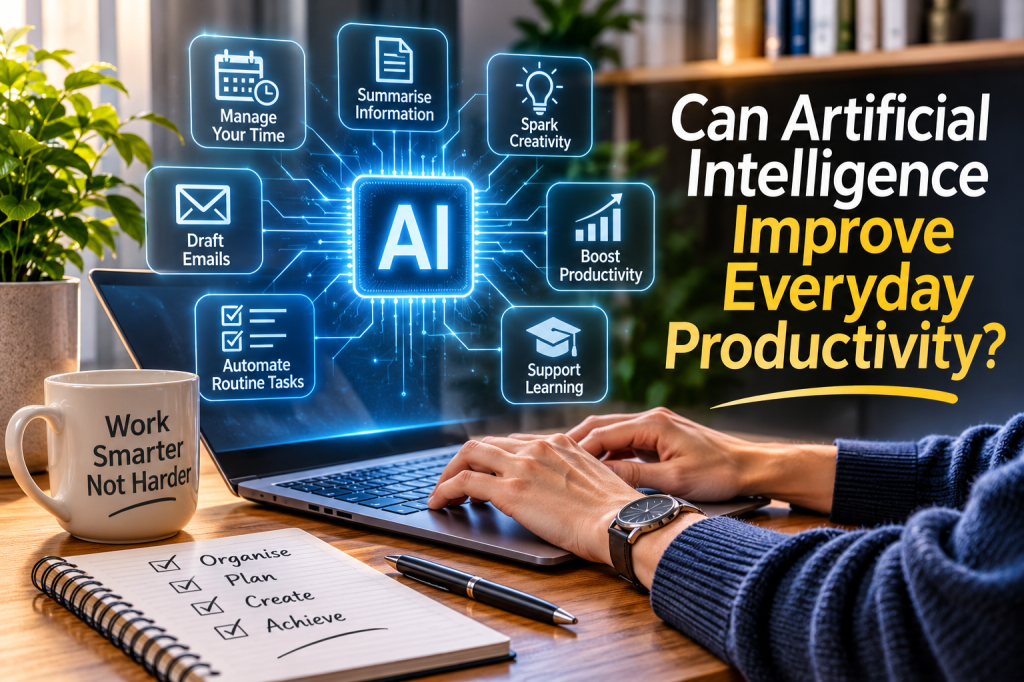
Artificial intelligence (AI) is becoming an increasingly familiar part of everyday life, changing the way people work, organise their responsibilities and manage their time. Once largely associated with specialist technology and complex computing, AI tools are now accessible to individuals, businesses, students and households.
One of the most interesting developments is the growing use of AI to improve everyday productivity. From organising schedules and drafting documents to researching information and managing repetitive tasks, artificial intelligence is creating new opportunities to work more efficiently.
Making Everyday Tasks Easier
One of the biggest advantages of AI is its ability to assist with routine tasks that can consume valuable time.
AI-powered applications can help users organise their diaries, create reminders, summarise lengthy documents, draft emails and structure daily schedules. Rather than spending considerable time on administrative responsibilities, individuals can use these tools to make certain processes quicker and more manageable.
For businesses, this can mean improving administrative efficiency and allowing employees to concentrate more attention on responsibilities that require human judgement, creativity and communication.
However, AI does not necessarily eliminate work. In many cases, it changes how work is completed.
Supporting Creativity and Learning
Artificial intelligence is also becoming a useful tool for people involved in creative and educational activities.
Writers can use AI to develop ideas, organise research and improve the structure of their work. Students can use it to explore difficult subjects, generate revision questions and receive explanations of unfamiliar concepts.
Similarly, individuals learning new skills can use AI applications to practise languages, explore subjects of interest and receive personalised explanations.
Importantly, AI should be viewed as a supporting resource rather than a replacement for independent thinking. Information generated by AI can contain mistakes, omissions or misleading conclusions, making human judgement and fact-checking essential.
Improving Workplace Productivity
Businesses across different industries are exploring how artificial intelligence can improve workplace productivity.
AI systems can assist with customer service enquiries, data analysis, document preparation, scheduling and the organisation of information. Some applications can also identify patterns in large amounts of data, helping organisations make more informed decisions.
For employees, the potential benefit is reduced time spent on repetitive activities. This may create more opportunities to concentrate on problem-solving, planning and tasks that require specialist knowledge.
Nevertheless, successful implementation depends on appropriate training, reliable technology and responsible use. Organisations must also consider data protection, confidentiality and the potential consequences of relying too heavily on automated systems.
The Importance of Human Involvement
Despite its advantages, artificial intelligence has limitations.
AI-generated information is not automatically accurate, and systems can misunderstand instructions, overlook important details or produce convincing but incorrect answers.
There are also concerns surrounding privacy, data security, employment and the growing dependence on technology.
For these reasons, people should remain actively involved in decisions and processes where accuracy, responsibility and personal judgement matter.
The most effective approach is to use AI to support human abilities rather than surrendering control to automated systems.
Can AI Really Save Time?
The answer depends largely on how it is used.
For someone managing a busy working day, AI may help reduce the time required to organise information, prepare documents or plan activities. For a small business, it may provide assistance with administrative responsibilities that would otherwise require additional resources.
However, learning to use AI effectively takes time, and checking its output remains an important part of the process.
Productivity is not simply about completing more tasks in less time. It is also about working intelligently, maintaining quality and making better use of available resources.
Finding the Right Balance
Artificial intelligence is unlikely to transform every aspect of everyday life overnight, but its influence on how people work, learn and organise themselves is becoming increasingly significant.
Used responsibly, it can provide practical assistance, reduce certain repetitive workloads and help people approach everyday responsibilities in new ways.
Ultimately, technology is most valuable when it gives people more time and opportunity to focus on what matters.
Artificial intelligence may be able to improve productivity, but the decisions, creativity and judgement that give work meaning remain fundamentally human.
Vion Lifestyle Magazine









Leave a Reply