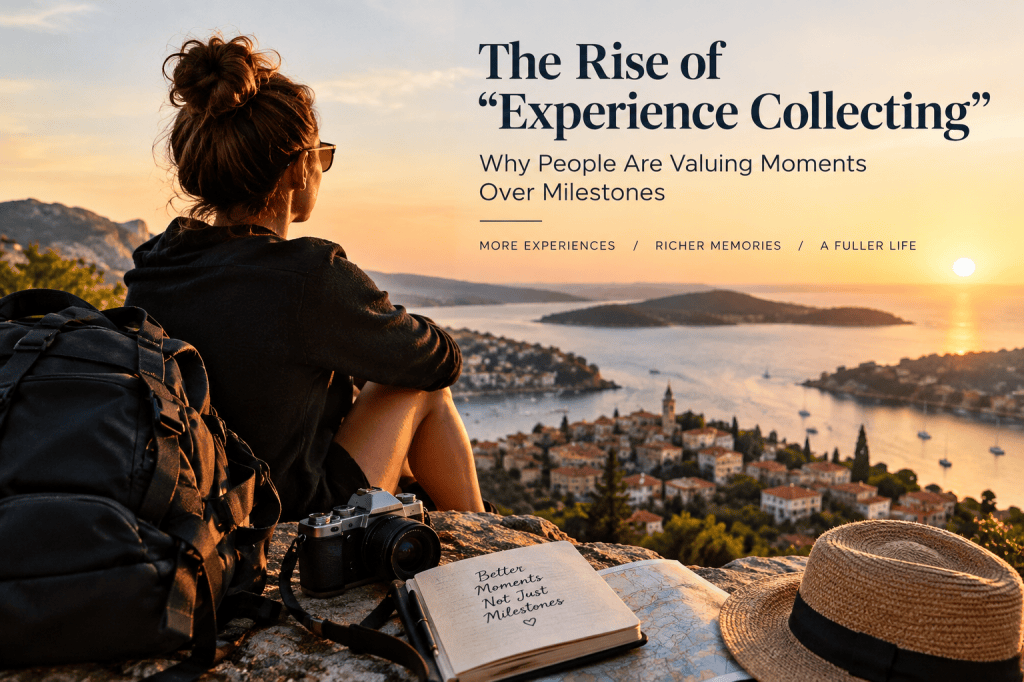
For generations, major life milestones have often been used as markers of success: buying a home, building a career, getting married, having children or reaching a particular financial goal. But a growing cultural interest in experiences is changing how some people think about what makes a life feel meaningful.
“Experience collecting” describes the idea of deliberately accumulating memorable experiences rather than measuring personal progress primarily through possessions, status or traditional milestones. The concept can range from travelling to unfamiliar places and attending concerts to learning new skills, exploring local communities, trying different foods or simply creating memorable moments with friends and family.
The trend is closely connected to a broader shift towards experiential spending. Research in consumer psychology has repeatedly examined the relationship between experiences, wellbeing and personal satisfaction, with studies suggesting that people can derive lasting value from experiences because they become part of their memories and personal identity.
Unlike physical possessions, experiences are temporary. Their value can come from anticipation, participation and the memories created afterwards. A holiday eventually ends, a concert lasts only a few hours and a meal is consumed, but the memory of those events can remain significant for years.
From Milestones to Memories
Traditional milestones are often externally visible. A promotion, new car or property purchase can provide a recognisable indication of progress. Experiences are generally more personal and can be difficult to measure in the same way.
For some people, this has encouraged a different approach to personal goals. Rather than asking only what they want to achieve, they may also ask what they want to experience.
That could mean visiting a particular country, watching a favourite artist perform live, taking up photography, learning a language, hiking somewhere new or spending more time exploring places closer to home.
The emphasis is not necessarily on expensive travel or luxury experiences. Experience collecting can also involve relatively simple activities, such as visiting a museum, discovering a new restaurant, taking a day trip, reading in an unfamiliar setting or attending a community event.
Why Experiences Can Become Part of Identity
Psychologists and consumer researchers have explored why experiences can have a different psychological value from material purchases. One explanation is that experiences become incorporated into a person’s life story.
A possession can communicate something about an individual, but an experience can become part of their autobiographical memory: the places they have visited, people they have met, challenges they have overcome and moments they remember.
Experiences can also provide opportunities for social connection. Shared activities create memories that can be revisited through conversations, photographs and stories long after the event itself has ended.
This helps explain why an ordinary day can sometimes become more memorable than an expensive purchase. Its importance may come from the circumstances surrounding it rather than its financial value.
Social Media Has Changed the Way Experiences Are Documented
The growth of social media has also transformed how experiences are recorded and shared. Holidays, concerts, restaurants and unusual activities can be photographed and instantly documented online.
However, the idea of experience collecting does not necessarily depend on public sharing. In an increasingly connected digital environment, some people are deliberately placing greater value on experiences that remain private.
A weekend away without posting photographs, an evening spent reading or a meal shared with close friends can be meaningful without becoming online content.
This reflects a wider interest in separating personal experiences from the pressure to constantly document them.
The Influence of the Cost-of-Living Era
Economic pressures have also complicated the relationship between experiences and spending. Travel, entertainment and hospitality can be expensive, meaning that experience-focused lifestyles are not equally accessible to everyone.
As a result, experience collecting does not have to mean spending more money. It can instead involve becoming more intentional about how existing time and resources are used.
Local tourism, free cultural events, outdoor activities, libraries, museums and community programmes can all provide opportunities to create experiences without the cost associated with international travel or luxury consumption.
The underlying principle is less about spending and more about deliberately creating memories.
A Different Definition of Success
The rise of experience collecting does not mean traditional milestones are disappearing. Career progression, home ownership, financial security and family life remain important goals for many people.
Instead, experiences can provide an additional way of thinking about personal fulfilment.
For some, success may increasingly be measured not only by what they own or achieve, but by what they have seen, learned, experienced and remembered.
That represents a subtle change in the language of personal ambition. Rather than building a life entirely around milestones, people may also be thinking about building a life filled with moments.
In that sense, experience collecting is less about creating an impressive list of destinations or activities and more about recognising that a meaningful life can be made up of ordinary moments as well as extraordinary ones.
The result is a broader definition of personal wealth: not simply the things someone accumulates, but the memories, relationships, knowledge and experiences they carry with them.









Leave a Reply