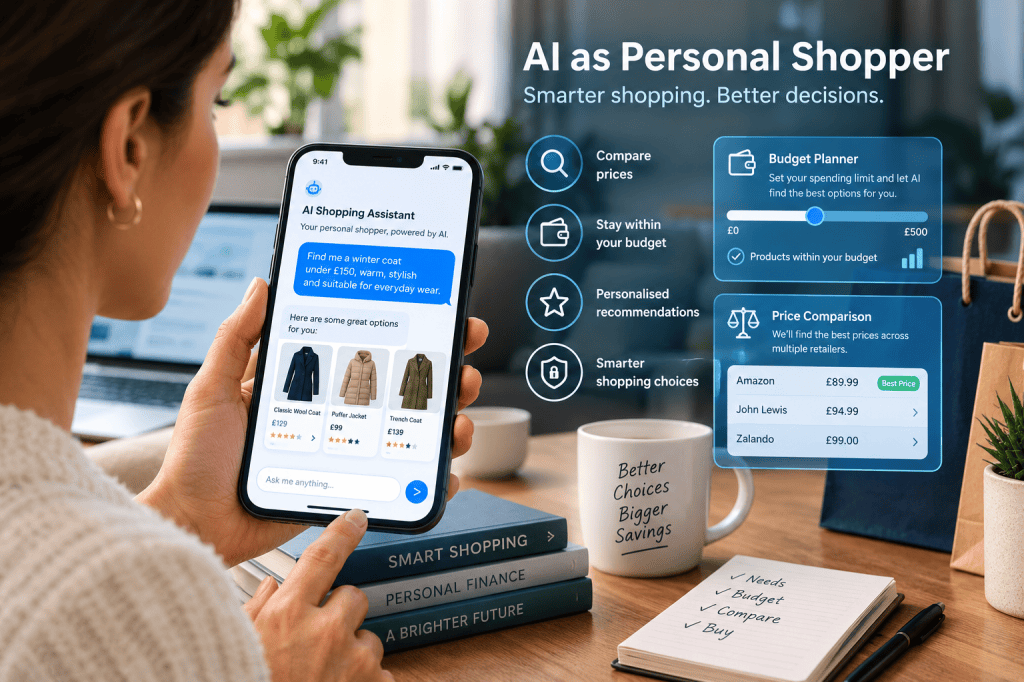
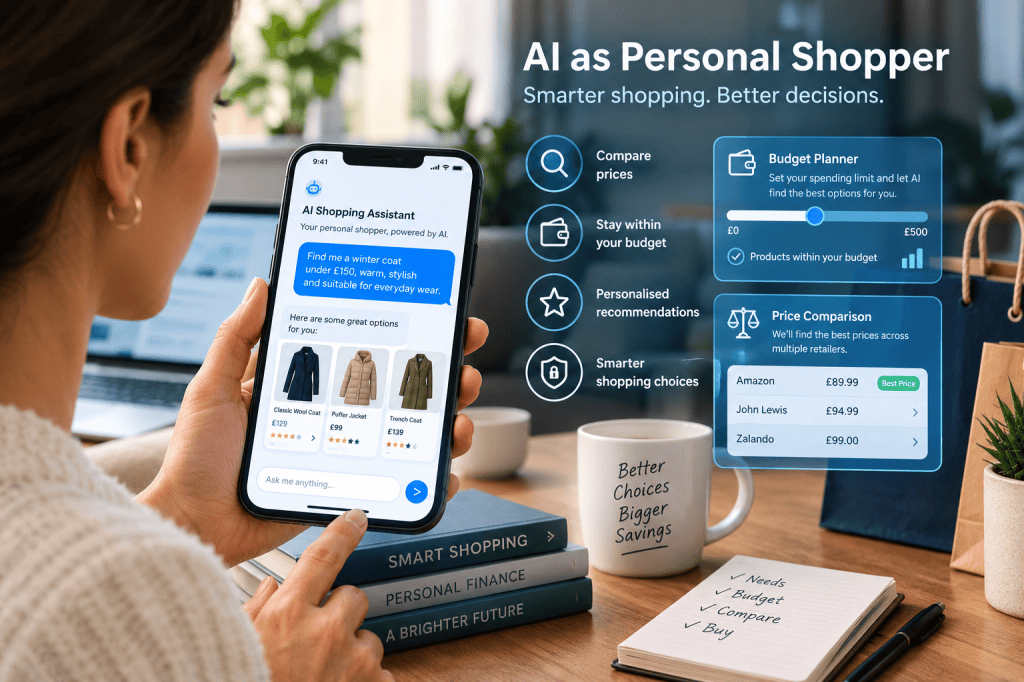
Artificial intelligence is increasingly becoming part of the everyday shopping experience, moving beyond simple product recommendations to help consumers compare prices, plan purchases and manage household budgets. The rise of AI-powered shopping tools is changing how people discover products and, increasingly, how they decide what is worth buying.
Traditionally, online shoppers have had to search across multiple websites, compare prices manually, read reviews and calculate whether a purchase fits within their budget. AI-powered shopping assistants can bring many of these tasks together, using information supplied by retailers and other online sources to provide personalised recommendations.
From Search Engine to Shopping Assistant
One of the most significant changes is the move from traditional keyword searches towards conversational shopping.
Instead of searching for a specific product, consumers can describe what they need in ordinary language. An AI assistant might be asked to find a laptop suitable for working from home, a winter coat below a particular price, or ingredients for several inexpensive family meals.
The technology can then analyse the requirements and produce a selection based on factors such as price, specifications, features and stated preferences.
This effectively turns AI into a digital personal shopper, although the quality of recommendations depends on the information available to the system and the accuracy of its product data.
AI and Personal Budgets
Budgeting is another area where AI-powered shopping tools could have a practical role.
Consumers can provide spending limits and ask AI to identify products within a particular price range. Some financial and shopping applications can also analyse spending patterns, categorise purchases and identify areas where consumers may be able to reduce expenditure.
For example, rather than simply looking for the cheapest available product, an AI assistant could help compare price, durability, specifications and reviews to identify options that meet a particular set of requirements.
The underlying idea is simple: shopping decisions can be based on a combination of price and value, rather than price alone.
The Growth of Personalisation
AI also allows shopping recommendations to become increasingly personalised.
A recommendation system can potentially take account of factors such as previous purchases, preferred brands, product specifications and stated budgets. This can make online shopping more convenient because consumers may not have to repeatedly explain their preferences.
However, personalisation also raises questions about privacy and how consumer data is collected, stored and used.
The more information an AI shopping assistant receives, the more personalised its recommendations can become. Consumers therefore need to understand what information they are providing and how the service uses it.
Finding Discounts and Comparing Prices
Price comparison has long been an important part of online shopping, but AI can make the process more conversational.
Instead of visiting several websites individually, a consumer can ask an AI system to compare available options according to specific criteria. Depending on the service, this may include price, delivery costs, product specifications and customer feedback.
AI can also help consumers identify whether a cheaper alternative might provide similar functionality to a more expensive product.
That could be particularly relevant during periods when household budgets are under pressure, as consumers increasingly look for ways to reduce unnecessary spending without abandoning purchases altogether.
The Risk of AI-Driven Impulse Buying
The technology is not automatically beneficial for consumers.
An AI assistant designed primarily around commercial recommendations could potentially make shopping more convenient while also making it easier to purchase products. Personalised recommendations can encourage additional browsing and expose consumers to products they had not originally intended to buy.
This creates an important distinction between AI as a budgeting assistant and AI as a sales tool.
Consumers should therefore remain aware of why a particular product has been recommended and whether the recommendation is based on their interests, commercial relationships, advertising or a combination of factors.
Consumers Still Need to Check the Details
AI can save time, but it does not eliminate the need for consumers to verify information.
Prices can change, products can go out of stock and specifications may be incorrectly interpreted or presented. Reviews can also vary considerably between customers.
Before making an expensive purchase, shoppers should check the retailer’s current information, return policy, warranty, delivery costs and final price.
AI should therefore be viewed as a research and decision-support tool rather than an automatic replacement for consumer judgement.
A New Era of Shopping
The emergence of AI personal shoppers reflects a broader change in online retail. Shopping is gradually moving from a process in which consumers search through large numbers of products towards systems that attempt to understand what the consumer actually wants.
For shoppers, the potential advantages are significant: less time spent searching, easier price comparisons, personalised recommendations and greater assistance with staying within a budget.
But the technology also brings new questions around privacy, transparency, commercial influence and accuracy.
As AI becomes more deeply integrated into retail and personal finance tools, the future of shopping may involve fewer searches and more conversations — with consumers explaining what they need, how much they want to spend and what matters most to them, while artificial intelligence helps narrow down the choices.
The final decision, however, remains with the shopper.









Leave a Reply