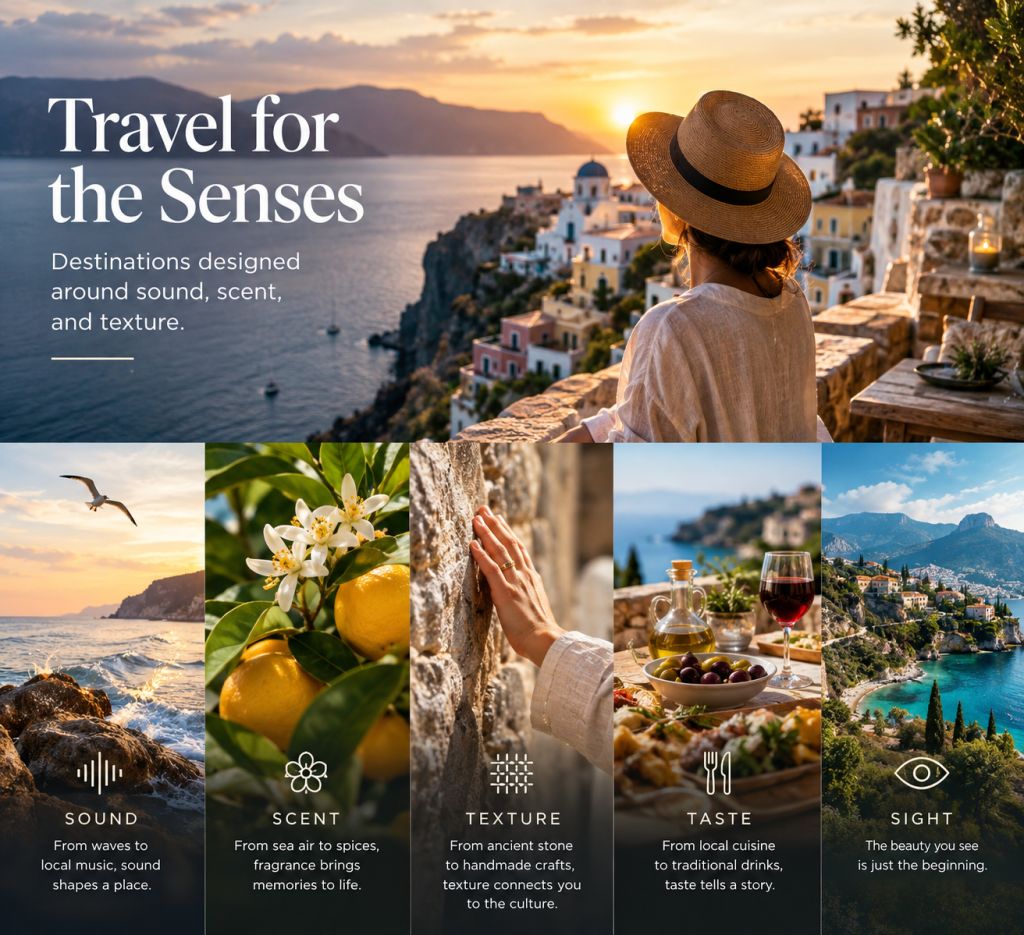
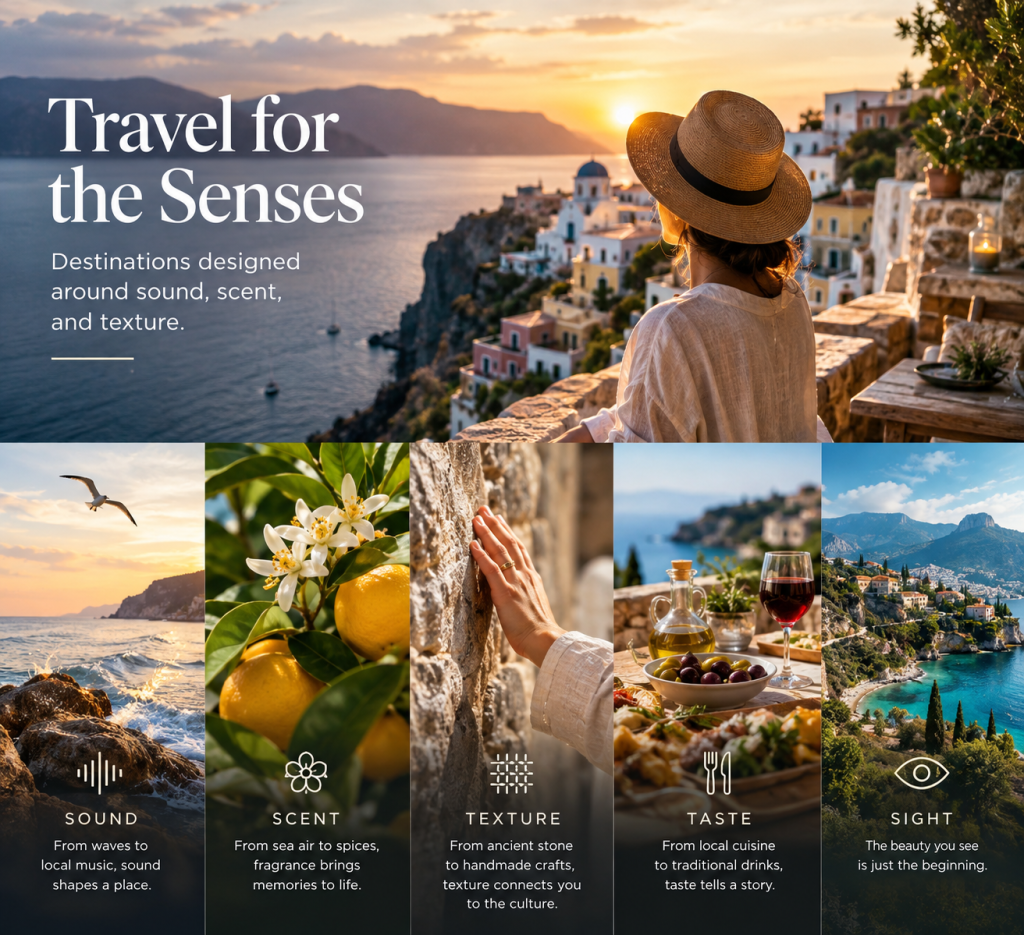
Travel has traditionally been associated with what people can see: famous landmarks, dramatic landscapes, historic buildings and picture-perfect beaches. But a growing area of travel and hospitality is placing greater emphasis on the other senses, creating experiences designed around sound, scent, taste and texture as well as sight.
Known broadly as sensory or multisensory travel, the approach reflects a wider interest in experiences that feel immersive rather than simply visual. Hotels, spas, restaurants, museums and tourism destinations are increasingly considering how their environments sound, smell and feel, from carefully selected music and natural soundscapes to locally inspired fragrances and tactile materials.
Beyond the photograph
Social media has helped make visual appeal an important part of modern tourism, with destinations often promoted through photographs and short-form video. However, travel itself involves considerably more than visual stimulation.
The sound of waves, birdsong or a busy market can become strongly associated with a particular destination. The smell of pine forests, sea air, spices, coffee or freshly prepared food can also contribute to how people remember a place.
Researchers studying the relationship between the senses and memory have long recognised that sensory information can become connected with emotional and autobiographical memories. Smell is particularly notable because the olfactory system has close connections with areas of the brain involved in emotion and memory.
This helps explain why returning to a particular destination — or encountering a familiar smell or sound years later — can sometimes bring back memories of a previous journey.
Designing destinations around sound
Sound is becoming an increasingly deliberate part of hospitality and tourism design.
Hotels and wellness retreats may use carefully selected background music, natural recordings or quieter spaces to create different atmospheres. Some destinations also incorporate sound into cultural experiences, including traditional music, local performances and guided experiences focused on natural soundscapes.
The concept extends beyond entertainment. Urban planners and architects have increasingly examined soundscapes, recognising that the sounds surrounding people can influence how they experience public spaces.
A quiet woodland, a Mediterranean village square and a major city all have distinctive acoustic environments. For travellers, these sounds can become part of the identity of a destination just as much as its architecture.
The power of scent
Scent is another increasingly important element of experiential travel.
Some hotels and hospitality businesses use signature fragrances to establish a distinctive atmosphere. Destinations can also naturally provide their own scents, whether it is the smell of coastal air, flowers, forests, spices, local food or traditional markets.
The tourism industry has an obvious commercial interest in this area. A distinctive scent can potentially help establish a recognisable identity for a hotel, spa or brand.
However, scent can also be highly personal. What one traveller finds relaxing or nostalgic may be unpleasant to another, meaning sensory design needs to take individual differences into account.
Texture and touch
Texture is another element that can easily be overlooked when discussing travel.
Traditional buildings, stone streets, wooden furniture, handmade textiles, ceramics and natural materials can provide tactile experiences that differ significantly from highly standardised modern environments.
Wellness destinations have particularly embraced tactile design, using materials such as wood, stone, wool and natural fibres to create environments intended to feel calm and connected to nature.
For travellers, touching locally produced crafts or experiencing traditional materials can also provide a more direct connection with a destination’s culture.
Nature as the original multisensory experience
Many of the strongest sensory travel experiences do not require sophisticated technology.
Walking through a forest provides changing sounds, scents, textures, temperatures and light. A visit to a coastline combines the sound of waves with salt air, wind, sand and changing temperatures. Markets can combine music, conversation, food aromas, colours and tactile experiences within a single environment.
This has helped contribute to interest in slow travel and nature-based tourism, where the emphasis is often placed on experiencing a location rather than simply visiting as many attractions as possible.
Technology enters the experience
Technology is also beginning to expand the possibilities of multisensory tourism.
Immersive exhibitions can combine visual projections with sound, lighting and physical environments. Virtual and augmented reality can add digital soundscapes and interactive elements to cultural experiences, while smart hotel systems can allow guests to customise lighting, music and room environments.
The development of these technologies raises the possibility of increasingly personalised travel experiences, where environments could be adjusted according to individual preferences.
However, technology is not necessarily the defining feature of sensory travel. In many cases, the appeal lies precisely in stepping away from screens and experiencing the physical environment directly.
A different way to remember a destination
The growing interest in sensory travel reflects a broader shift in tourism towards experiences rather than simply destinations.
Travellers may remember the sound of rain on a hotel roof, the smell of a particular market, the texture of an old stone building or the taste of a meal long after photographs have been forgotten.
As the travel industry continues to explore wellness, slow travel, nature and immersive experiences, the senses are becoming an increasingly important part of destination design.
The future of travel may therefore be less about simply asking, “What can I see?” and more about asking, “What can I hear, smell, touch, taste and feel?”
For destinations looking to create lasting memories, the answer could be found not in another landmark, but in the complete sensory experience of being there.









Leave a Reply