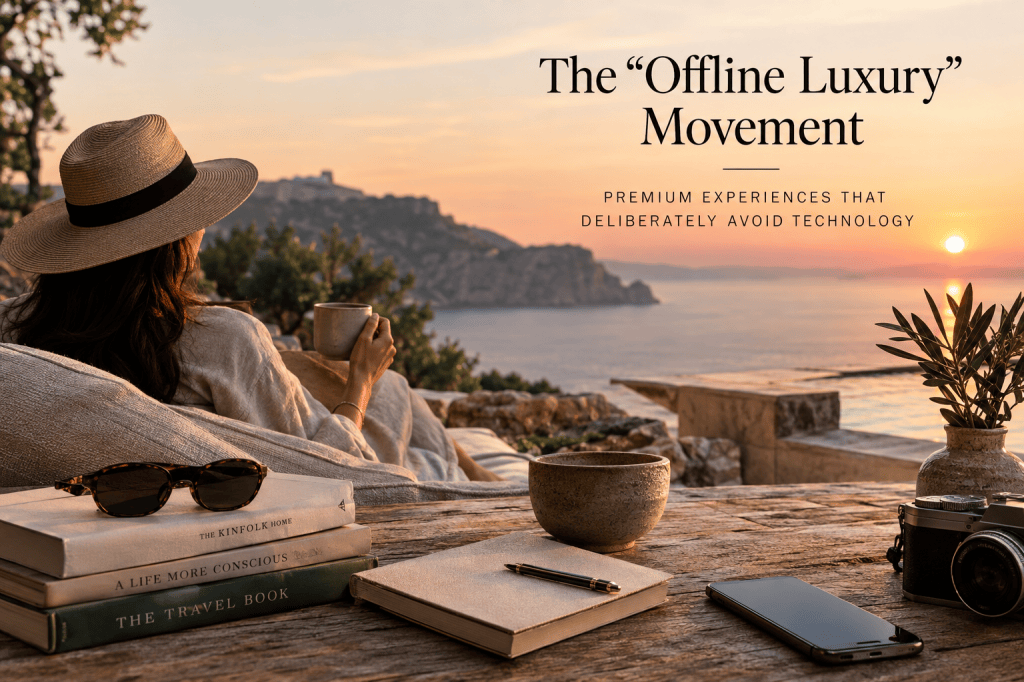
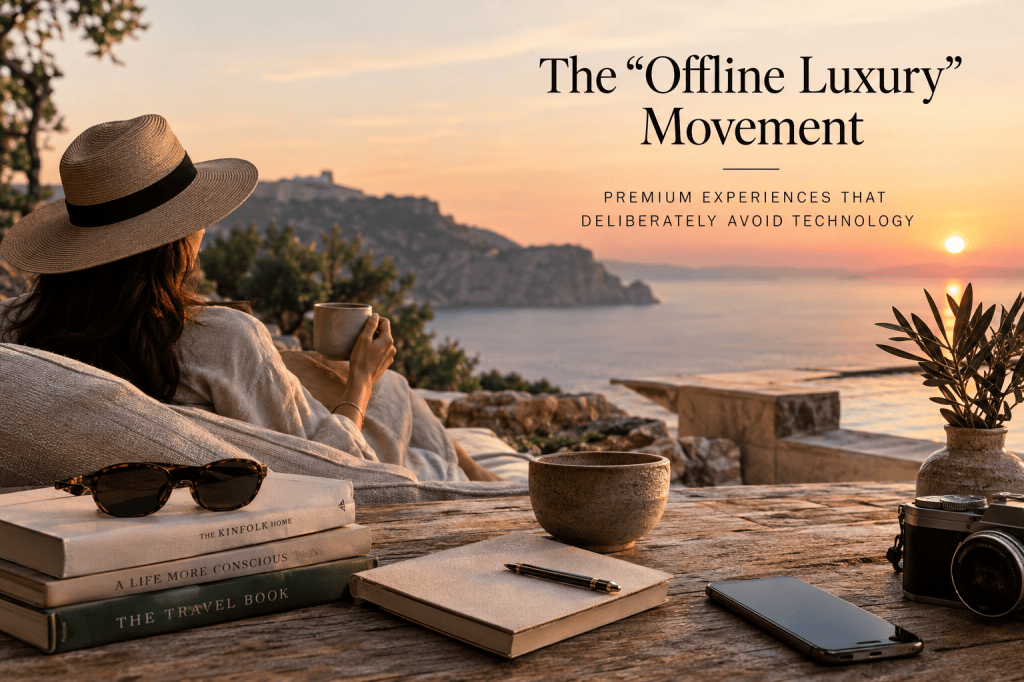
For years, luxury has been closely associated with technology. Smart hotel rooms, digital concierge services, app-controlled lighting, wearable devices and connected entertainment have increasingly become part of the premium experience. Now, however, another form of luxury is gaining attention: deliberately switching technology off.
The emerging “offline luxury” movement centres on experiences designed to reduce or remove digital distractions. Rather than offering guests more screens, connectivity and automation, these experiences place greater emphasis on privacy, quiet, personal attention and time away from smartphones and other connected devices.
Luxury Without the Screen
The concept is appearing across parts of the hospitality, travel and wellness industries. Some retreats and hotels encourage guests to disconnect from their devices, while technology-free experiences can include phone-free dining, analogue entertainment, nature-based activities and spaces where digital connectivity is deliberately limited.
For consumers accustomed to constant notifications, emails and social-media updates, the absence of technology can itself become part of the experience.
The appeal is not necessarily a rejection of technology. Instead, offline luxury treats disconnection as something that can be intentionally chosen for a limited period.
From Digital Detox to Premium Experience
Technology-free retreats are not entirely new. Digital-detox holidays and wellness programmes have existed for years, particularly at properties focused on mindfulness, relaxation and outdoor experiences.
What is changing is the way the idea is being positioned. Rather than simply being presented as a response to excessive screen use, disconnecting can increasingly be incorporated into the broader language of luxury.
A secluded room without a television, a meal where phones are put away, handwritten correspondence, physical books, board games, fireside conversations and guided walks can all become components of an experience built around slowing down.
In this context, time and attention become part of the luxury offering.
Why Consumers Are Interested
The growth of remote work, smartphones, social media and always-connected services has blurred the boundaries between work, leisure and personal time. For many people, being technically reachable does not necessarily mean being mentally present.
Research into smartphone use and digital behaviour has also examined associations between heavy or problematic use and factors such as stress, sleep disruption and reduced wellbeing. However, the evidence is complex, and technology itself can also provide significant social, practical and health benefits.
Offline luxury therefore represents a lifestyle choice rather than a universal solution to digital fatigue.
For some consumers, the attraction may simply be the opportunity to spend several hours or days without having to respond to notifications, photograph an experience or remain available online.
The Return of Analogue Experiences
The movement also coincides with renewed interest in analogue activities.
Vinyl records, printed books, film photography, handwritten letters, physical newspapers and traditional games have all retained or regained cultural appeal despite the availability of digital alternatives.
Within luxury hospitality, these analogue elements can be transformed into carefully designed experiences. A hotel might provide a collection of books instead of streaming services, offer a traditional writing desk rather than a tablet, or create spaces designed specifically for conversation rather than screen-based entertainment.
The objective is not necessarily to recreate the past. Instead, analogue activities can provide a deliberate contrast to an increasingly digital everyday environment.
Privacy as a Luxury
Another important element of offline luxury is privacy.
Luxury consumers have traditionally paid for private villas, secluded resorts, personal service and exclusive experiences. Disconnecting from technology adds another dimension to that concept.
A private environment where guests are not expected to document their activities or communicate constantly online can provide a stronger sense of separation from everyday life.
This is particularly relevant at a time when personal experiences are frequently shared publicly through social-media platforms. An experience that cannot easily be photographed, posted or livestreamed can become valuable precisely because it remains personal.
A Different Definition of Convenience
Modern luxury has often been defined by convenience: faster communication, automated services, digital check-in and instant access to information.
Offline luxury turns that idea on its head.
Instead of asking how technology can make an experience faster, the question becomes whether an experience should be slowed down.
A handwritten menu, face-to-face concierge service or meal without smartphones may take more time than a digital alternative. That additional time can become part of the appeal.
For consumers increasingly surrounded by automation, human interaction itself can become a premium feature.
Not Anti-Technology
Importantly, offline luxury should not necessarily be interpreted as an anti-technology movement.
Many people embracing digital-detox experiences continue to use smartphones, computers, streaming services and other technology in their everyday lives. The attraction lies in having greater control over when technology is used and when it is deliberately left behind.
This makes offline luxury less about abandoning technology permanently and more about creating boundaries around it.
The Future of Luxury
The luxury industry has historically adapted to changing ideas about what consumers value. As technology becomes increasingly integrated into everyday life, the ability to escape it may become another form of premium experience.
The next generation of luxury may therefore involve an interesting contradiction: paying for less connectivity rather than more.
For some travellers and consumers, the ultimate indulgence may not be faster Wi-Fi, another smart device or a more sophisticated app. It may simply be a quiet room, a good meal, a physical book and several uninterrupted hours in which nobody expects them to be online.
In an increasingly connected world, the freedom to disconnect could become one of the most exclusive experiences of all.









Leave a Reply