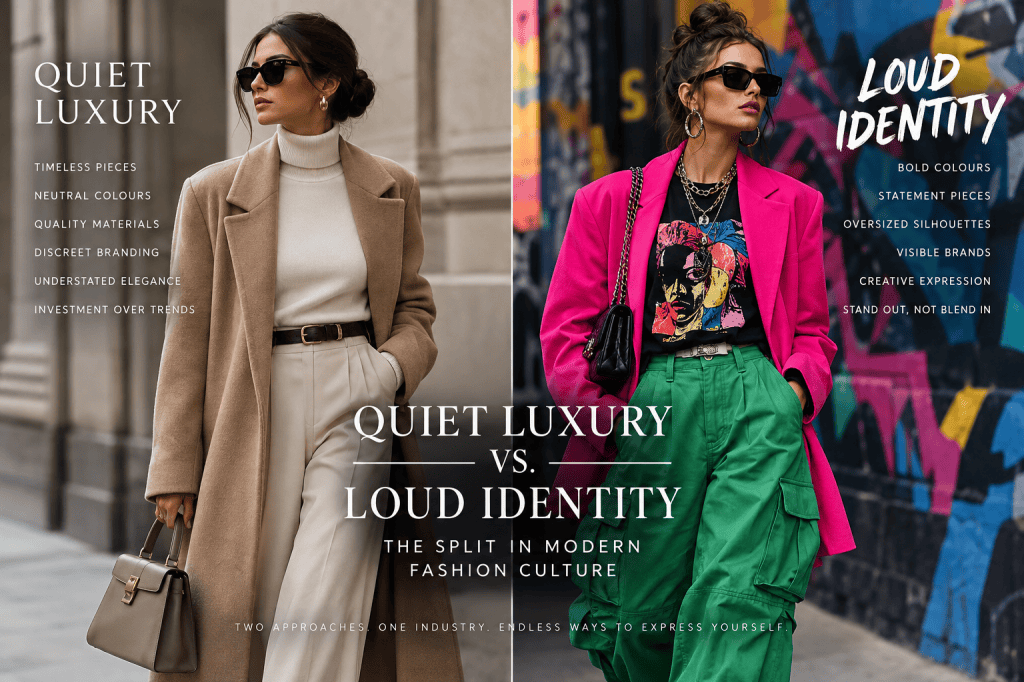
Fashion has always been about more than clothing. It can communicate personality, status, creativity, belonging and individuality without requiring a single word. Today, that conversation is increasingly visible in the contrast between quiet luxury and what might be described as loud identity — two different approaches to expressing style in a rapidly changing fashion culture.
Neither represents a single fashion rule. Instead, they reflect different attitudes towards how people want to be seen.
The Rise of Quiet Luxury
Quiet luxury became one of the most discussed fashion movements of the 2020s. Its appeal lies in understatement: neutral colours, clean silhouettes, high-quality materials, restrained branding and pieces designed to remain relevant beyond a single season.
Rather than prominently displaying a designer logo, quiet-luxury dressing often places emphasis on construction, fabric, fit and craftsmanship.
The aesthetic has connections with longstanding traditions of understated dressing, particularly among luxury houses known for discreet branding and timeless designs. Its modern popularity has also been associated with television, celebrity fashion and social-media culture, where carefully styled wardrobes can communicate sophistication without obvious branding.
At its heart, the idea is simple: luxury does not necessarily have to announce itself.
But Fashion Is Also Becoming Louder
At the same time, another side of modern fashion culture is moving in almost the opposite direction.
Bold colours, oversized silhouettes, dramatic accessories, statement graphics, distinctive makeup and highly visible branding have become important tools for self-expression. For many people, clothing is not about blending into an understated aesthetic but about creating an unmistakable visual identity.
This approach can be particularly visible among younger consumers and on social-media platforms, where distinctive outfits can become part of a person’s digital identity.
The attraction is understandable. In an environment filled with images, individuality can become a form of communication.
A striking outfit can say: this is who I am, this is what I enjoy, and this is how I want to be seen.
From Status to Self-Expression
The difference between the two approaches reflects a broader change in the way fashion can communicate status.
Traditional luxury often relied heavily on recognisable symbols. A particular logo, handbag, watch or garment could immediately communicate the brand being worn.
Quiet luxury takes a more discreet approach, while loud identity can deliberately embrace recognisable symbols, unusual combinations and visual experimentation.
Interestingly, both can serve the same fundamental purpose: communication through appearance.
The difference is largely in the language being used.
Quiet luxury speaks softly through fabric, proportion and subtle detail. Loud identity speaks through colour, graphics, silhouettes and visual impact.
Social Media Has Changed the Conversation
Social media has made personal style more visible than ever.
Platforms such as Instagram, TikTok and Pinterest allow people to document outfits, discover designers and participate in rapidly changing aesthetics. Fashion trends that once took months or years to spread can now reach international audiences within days.
This has also encouraged people to experiment with multiple identities.
Someone might embrace minimalist tailoring for work, vintage clothing at the weekend and bold streetwear for an evening out. Fashion no longer has to represent one permanent identity.
Instead, it can become a constantly evolving form of personal storytelling.
The Return of Individuality
One of the most positive aspects of this divide is that modern fashion does not require everyone to follow the same aesthetic.
Quiet luxury has demonstrated that understated clothing can feel sophisticated and contemporary. At the same time, the popularity of expressive dressing shows that there remains a strong appetite for creativity and individuality.
The two approaches can even exist within the same wardrobe.
A simple tailored coat can be paired with an eye-catching bag. Minimalist trousers can be worn with a graphic shirt. A classic outfit can be transformed through jewellery, footwear or accessories.
Modern fashion therefore does not necessarily have to choose between quiet and loud.
A More Personal Fashion Culture
Perhaps the most interesting development is that consumers increasingly have the opportunity to decide what fashion means to them.
For some, style is about longevity and investment. For others, it is about experimentation, creativity and making a statement. Many people move between the two depending on their mood, lifestyle, budget or occasion.
That flexibility represents an important evolution in fashion culture.
The most compelling wardrobes are not necessarily those that perfectly follow one trend. They are often the ones that reflect the person wearing them.
Whether expressed through an impeccably cut neutral coat or an unforgettable statement piece, fashion remains one of the simplest ways to communicate individuality.
Quiet luxury and loud identity may appear to be opposites, but both demonstrate the same enduring truth: modern fashion is ultimately about choosing how you want to present yourself to the world.








Leave a Reply