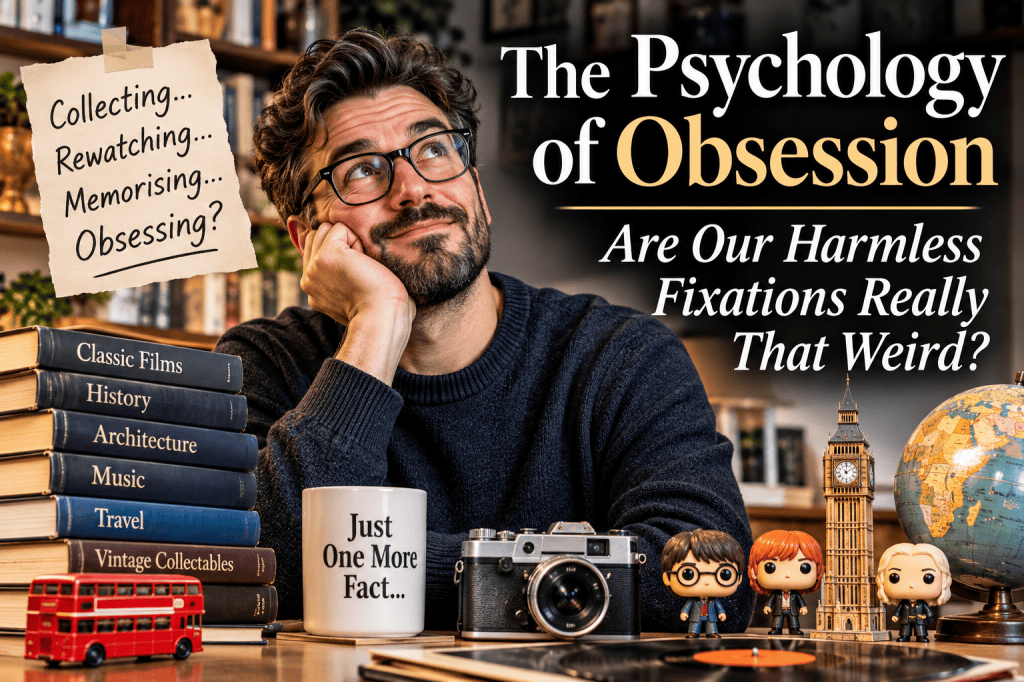
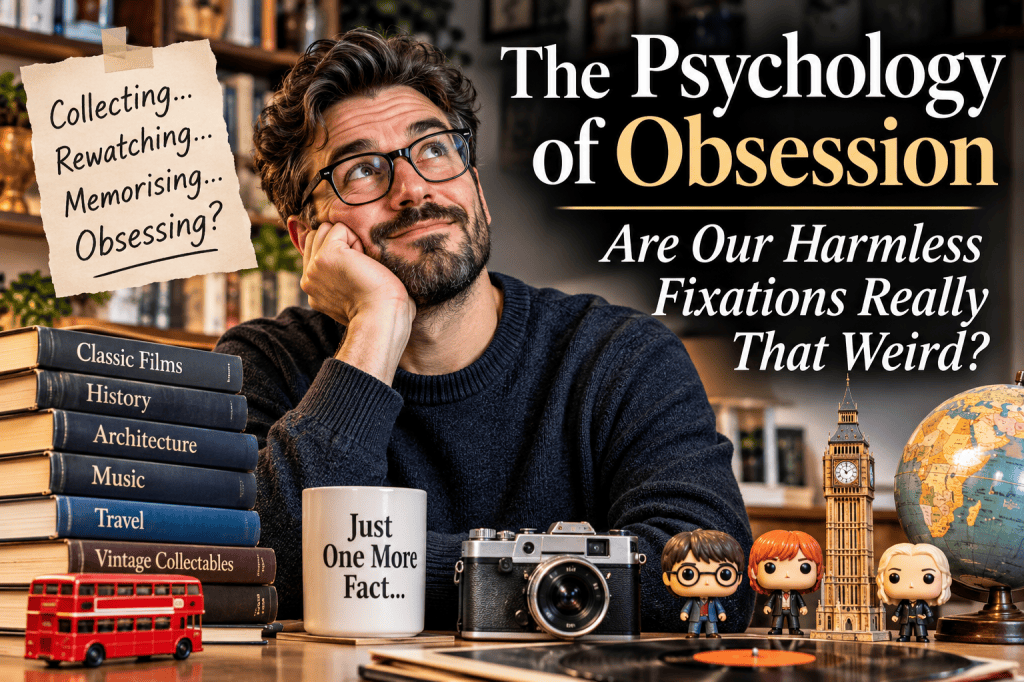
What’s the weirdest (harmless) obsession you’ve ever had?
We all have them. Those little habits, unusual interests or recurring thoughts that occupy more of our attention than we might care to admit. Whether it is collecting unusual objects, memorising obscure facts, watching the same television programme repeatedly or having an inexplicable fascination with something most people would overlook, harmless obsessions are a surprisingly common part of human behaviour.
But what exactly is an obsession, and should we really consider these interests weird?
What Do We Mean by Obsession?
In everyday conversation, the word obsession is often used to describe an intense interest in something. It might be a particular hobby, a favourite celebrity, a fascination with history or even a determination to own every available version of a particular object.
Psychologically, however, the term has a more specific meaning.
Clinical obsessions are recurrent, persistent and often unwanted thoughts, urges or images that can cause significant distress. They are associated with conditions such as obsessive-compulsive disorder (OCD).
This is quite different from having an enthusiastic interest in something that brings enjoyment and does not interfere with everyday life.
Understanding that distinction is important because not every unusual fascination is a psychological problem.
Why Do We Develop Unusual Obsessions?
There are several reasons why people become particularly interested in certain subjects or activities.
Comfort and familiarity
Repeating enjoyable activities can provide a sense of comfort and predictability. Watching a favourite film for the twentieth time, listening to the same album or following a familiar routine can offer reassurance in an otherwise unpredictable world.
Curiosity and discovery
Some people are naturally drawn towards subjects that others might consider obscure. From abandoned buildings and forgotten inventions to vintage advertisements and unusual historical events, curiosity can lead people down fascinating intellectual paths.
A sense of identity
Hobbies and collections can become an important part of how people express themselves. Collecting books, vintage clothing, records or unusual memorabilia can provide a sense of personal identity and achievement.
Enjoyment and reward
Activities that people find enjoyable can activate the brain’s reward systems. This helps explain why certain hobbies, interests and pastimes can become particularly absorbing.
What Are Some Harmless Obsessions?
The possibilities are almost endless, and many are more common than people realise.
- Collecting something unusual, from vintage teaspoons to miniature buildings.
- Memorising film dialogue or television quotations.
- Knowing an extraordinary amount about a particular historical period.
- Watching the same favourite film repeatedly.
- Organising books, records or possessions in very specific ways.
- Taking photographs of doors, windows, architecture or street signs.
- Following the weather, railway timetables or aircraft movements.
- Having an extensive collection of something most people would never think to collect.
- Listening to one particular song repeatedly for days.
- Researching obscure subjects simply because they are interesting.
While some of these interests might appear unusual to other people, they are not automatically unhealthy.
In fact, many can encourage creativity, learning, concentration and social connections with people who share similar interests.
When Does an Obsession Become a Problem?
There is an important difference between an enjoyable fixation and an obsession that negatively affects someone’s life.
A healthy interest generally remains voluntary, enjoyable and manageable. Someone can put it aside when necessary and continue with their responsibilities.
A more concerning pattern may involve intrusive thoughts, overwhelming anxiety, compulsive behaviours or an inability to disengage despite wanting to do so.
When thoughts or behaviours cause significant distress, consume substantial amounts of time or interfere with relationships, work and everyday activities, professional advice may be beneficial.
It is also important not to confuse unusual hobbies or personal preferences with OCD. The condition is considerably more complex than simply liking things organised or having particular routines.
Perhaps Weird Is Just Another Word for Individuality
Society has a habit of categorising behaviour. What one person considers strange, another might regard as fascinating.
Someone who spends hours researching Victorian architecture might seem unusual to a person with little interest in history. Yet that same individual might find another person’s fascination with football statistics equally puzzling.
The reality is that harmless obsessions often reveal something interesting about human individuality. They can demonstrate curiosity, imagination, passion and the simple pleasure of discovering something that captures our attention.
Perhaps the better question is not whether an interest is weird, but whether it brings happiness without causing harm.
Conclusion: Embrace the Harmlessly Unusual
Our interests do not have to be conventional to be worthwhile. Some of the most interesting conversations begin with subjects that others might initially consider unusual.
Whether it is an extraordinary collection, an obscure area of knowledge or a fascination that friends and family simply do not understand, harmless obsessions can make life a little more interesting.
After all, being different is not necessarily something that needs correcting.
So, what is the weirdest harmless obsession you have ever had? And more importantly, what makes it so fascinating to you?
Perhaps it is time we celebrated the wonderfully unusual things that make us individuals.






Leave a Reply