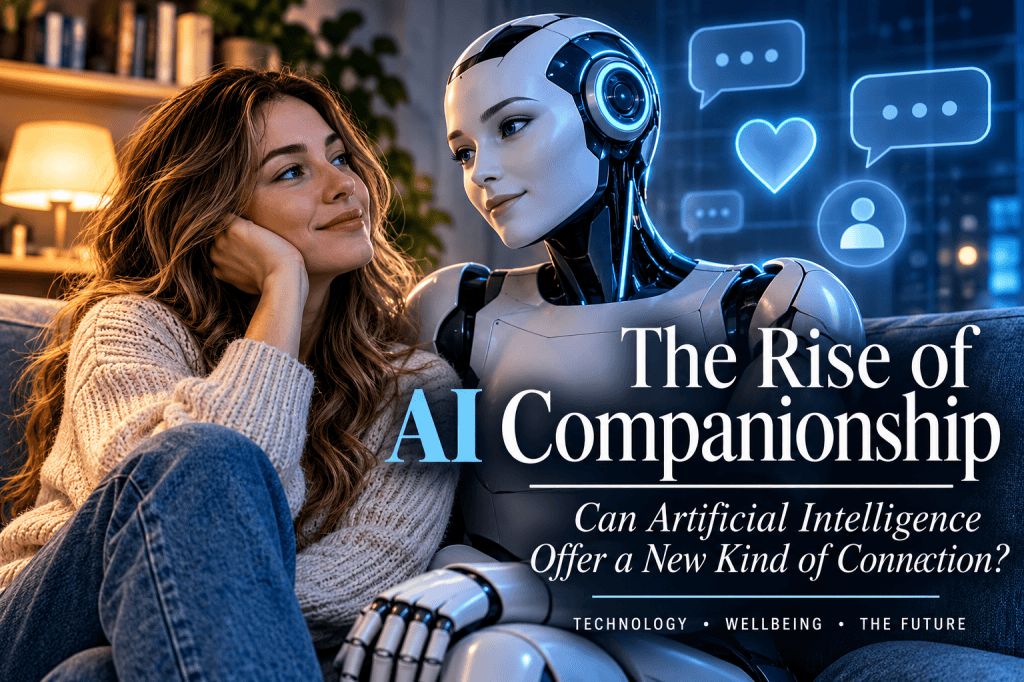
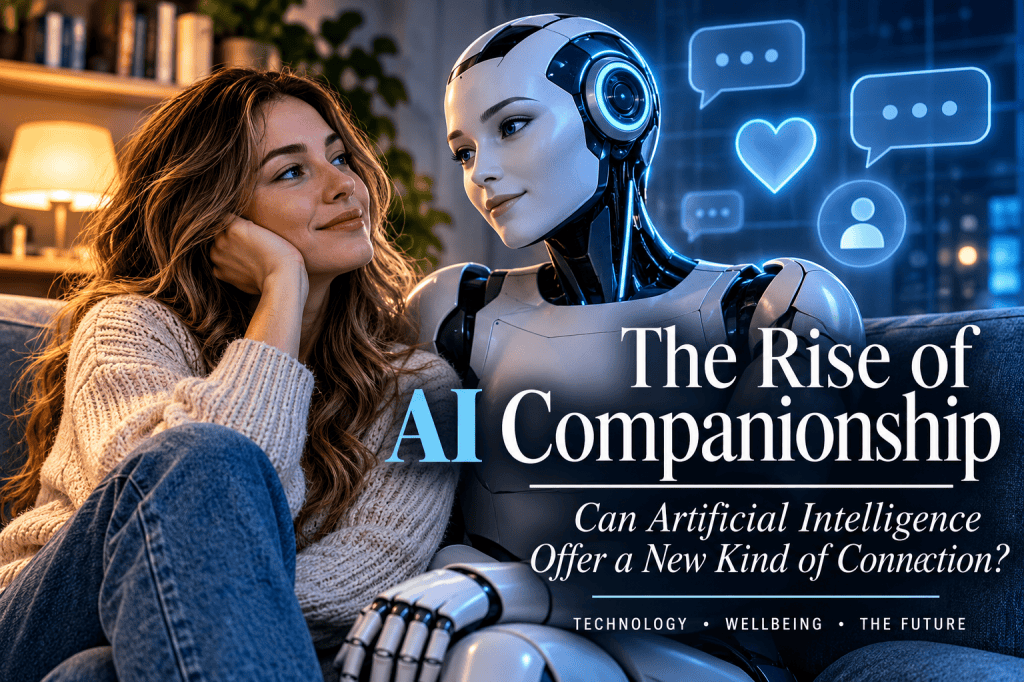
Artificial intelligence is changing the way people communicate, seek support and experience companionship. As AI-powered companions become increasingly sophisticated, society faces an important question: can technology provide meaningful emotional support, and what happens when people begin forming relationships with machines?
A New Era of Digital Companionship
Artificial intelligence has developed considerably beyond its early use in simple question-and-answer systems. Modern conversational AI can maintain extended discussions, respond to personal concerns, adapt its communication style and provide increasingly personalised interactions.
These developments have contributed to the emergence of AI companionship: the use of artificial intelligence systems designed to simulate friendship, emotional support or romantic relationships.
Unlike conventional digital assistants, which are primarily designed to complete tasks, AI companions are intended to provide ongoing social interaction. Some applications allow users to create personalised digital personalities, choose conversational characteristics and develop an ongoing relationship with an AI character.
For some people, these interactions are a source of entertainment or curiosity. Others use them to discuss their feelings, explore personal challenges or experience a sense of companionship when human contact is limited.
The growing interest in these systems reflects a wider change in how people interact with technology. Digital communication is no longer restricted to exchanging information; it increasingly attempts to reproduce aspects of human conversation and social connection.
Why Are People Turning to AI Companions?
There is no single explanation for the appeal of AI companionship.
One important factor is accessibility. An AI companion can often be accessed through a smartphone or computer, allowing users to start a conversation whenever they have time. Unlike human relationships, these systems do not require coordinating schedules or arranging face-to-face meetings.
Another attraction is the opportunity to talk without feeling immediately judged. Some users may find it easier to discuss sensitive subjects with a chatbot than with another person, particularly when they feel embarrassed, anxious or uncertain about how their concerns will be received.
AI companions can also provide opportunities for creativity and self-expression. Users may engage in fictional role-playing, practise conversations, explore hypothetical situations or experiment with different ways of expressing themselves.
Research published in the Journal of Consumer Research in 2025 found that AI companion interactions could produce short-term reductions in reported loneliness. The researchers highlighted the importance of users feeling heard during these conversations.
However, temporary relief from loneliness should not automatically be interpreted as evidence that AI companionship can replace lasting human relationships. The long-term effects remain an important subject of research.
Can Artificial Intelligence Provide Emotional Support?
One of the most interesting aspects of AI companionship is its ability to respond to emotional language.
Modern conversational systems can recognise expressions of sadness, frustration or uncertainty and generate responses intended to acknowledge those feelings. They may offer encouragement, help users organise their thoughts or suggest practical ways to approach a difficult situation.
For someone experiencing a stressful day, having an opportunity to express their thoughts through conversation may feel reassuring.
AI can also provide a useful starting point for reflection. A person might use a conversation to explore a disagreement, consider different perspectives or prepare to discuss a sensitive subject with a friend or family member.
Nevertheless, it is important to distinguish between an AI system producing an empathetic response and a human being experiencing empathy.
An AI companion generates responses through computational processes. It does not establish that the system possesses human consciousness, personal experiences or genuine emotions.
Although the resulting conversation may feel meaningful to the user, the technology behind it remains fundamentally different from a relationship between two people.
This distinction does not mean that every interaction is without value. Rather, it highlights the importance of understanding what AI can offer and where its limitations begin.
The Appeal of a Relationship Without Conflict
Human relationships can be rewarding, but they also require patience, compromise and emotional effort.
Friendships, romantic partnerships and family relationships involve people with independent needs, opinions and boundaries. Disagreements are inevitable, and maintaining meaningful connections often requires difficult conversations.
AI companionship can offer a different experience. Depending on how an application is designed, an AI character may be consistently available, highly responsive and willing to follow the conversational direction chosen by the user.
For some people, this predictability may be comforting.
However, the absence of ordinary relationship challenges can also create unrealistic expectations. Human beings cannot always respond immediately, agree with our opinions or provide precisely the reassurance we want.
If someone becomes accustomed to a relationship in which the other participant is designed to accommodate them, ordinary human interactions may feel more demanding by comparison.
Healthy relationships require mutual understanding, independence and respect. These qualities cannot be fully reproduced simply by programming a system to respond in an agreeable manner.
The Risks of Emotional Dependence
While AI companionship may provide benefits for some users, concerns remain about the possibility of emotional dependence.
A person who regularly turns to an AI companion for reassurance may gradually begin relying on it as their primary source of emotional support. This could become problematic if their use of the technology reduces their willingness to maintain friendships, seek help or participate in everyday social activities.
Research published in Nature Human Behaviour in August 2026 examined AI companionship and psychological well-being among users of Character.AI. The study found associations between companionship-focused chatbot use, smaller social networks and lower reported well-being.
The researchers also found that the relationship varied according to how people used the technology and their existing social circumstances.
These findings should be interpreted carefully. Associations do not establish that AI companionship itself causes poorer well-being, and the experiences of one group of users cannot automatically be applied to everyone.
Nevertheless, the research reinforces the importance of considering how AI companionship fits into a person’s wider life.
An AI companion may be a useful addition to someone’s routine, but it becomes more concerning if it replaces nearly all meaningful contact with other people.
Privacy and Personal Information
Another important consideration is privacy.
Conversations with AI companions can become highly personal. Users may disclose information about their relationships, finances, emotional difficulties, family circumstances or private experiences.
Before using an AI companionship service, it is sensible to understand how the provider collects, stores and processes conversational data.
Depending on the service, information may be retained, reviewed or used to improve products, subject to the provider’s policies and applicable law.
Users should therefore avoid assuming that every conversation is completely confidential simply because it takes place in a private chat window.
Practical precautions include:
- Reading the service’s privacy policy.
- Reviewing available data controls and account settings.
- Avoiding unnecessary disclosure of identifying information.
- Being cautious about sharing financial details, passwords or other sensitive information.
- Checking whether conversations can be deleted and what deletion actually covers.
Privacy deserves particular attention when an application encourages users to develop an ongoing, emotionally intimate relationship with an AI character.
The more personal the conversation becomes, the more important it is to understand how that information may be handled.
AI Companionship and Romantic Relationships
Some AI applications are specifically designed to simulate romantic relationships.
Users may create digital partners, exchange affectionate messages and develop ongoing fictional relationship narratives. These experiences can range from light-hearted entertainment to interactions that users regard as emotionally significant.
The subject raises difficult questions about intimacy, attachment and the meaning of relationships in an increasingly digital society.
For some users, a simulated relationship may provide an opportunity to explore their preferences or express feelings they find difficult to discuss elsewhere.
However, AI-generated affection should not be confused with reciprocal human commitment. An artificial companion cannot independently share the full range of human experiences, responsibilities and vulnerabilities that underpin a real-world partnership.
There are also questions about the influence of commercial incentives. AI companionship services may operate through subscriptions or other paid features, making it important for users to understand the costs and terms of continued access.
People should be particularly cautious about making financial decisions because they feel emotionally attached to an AI character.
The central issue is not whether someone is permitted to enjoy a fictional or simulated relationship. It is whether that relationship remains a conscious choice that supports their wider life rather than becoming a source of isolation or financial pressure.
Could AI Companions Help Address Loneliness?
Loneliness is a complex human experience. It can affect people at different stages of life, including those who have family, colleagues or friends around them.
A person may feel lonely because they lack close emotional connections, have recently experienced bereavement, are adjusting to a major life change or struggle to find people who share their interests.
AI companionship may provide temporary comfort in some of these circumstances.
A conversation can offer distraction, encourage reflection or give someone a place to express their thoughts. For people who have difficulty initiating social interactions, conversational AI may also provide an opportunity to practise communication in a low-pressure setting.
However, technology cannot address every underlying cause of loneliness.
Building friendships, participating in community activities, maintaining family connections and seeking appropriate professional support may all play important roles in improving social well-being.
AI companionship is best considered a possible supplement to these activities rather than a universal solution.
Importantly, people who are experiencing persistent loneliness should not be made to feel that turning to technology is inherently wrong. The more useful question is whether their chosen form of companionship helps them live a fuller life.
What Does the Future Hold?
The future of AI companionship will depend on advances in technology, public attitudes, commercial decisions and the development of appropriate safeguards.
As conversational AI becomes more capable, users may encounter systems that combine text, realistic voices, animated characters and other forms of digital interaction.
These developments could make conversations feel increasingly natural and personalised.
They may also intensify existing concerns about emotional attachment, privacy, transparency and the influence of AI on human relationships.
Developers face an important responsibility to make it clear when users are interacting with artificial intelligence, explain how personal information is handled and consider the potential consequences of encouraging prolonged emotional engagement.
There is also a need for further independent research into the long-term effects of AI companionship, particularly among younger people and individuals who already experience social isolation.
Public discussion should avoid two extremes: assuming that AI companions are inherently harmful or treating them as a complete answer to human loneliness.
The evidence suggests a more complicated picture in which the effects depend on the individual, the technology and the circumstances in which it is used.
Finding a Healthy Balance
AI companionship represents a significant development in the relationship between technology and everyday life.
For some people, these systems offer entertainment, a space for reflection or temporary relief from feelings of isolation. For others, they raise legitimate concerns about dependence, privacy and the potential displacement of human relationships.
The most sensible approach is to use the technology with awareness and realistic expectations.
People can benefit from asking themselves whether their interactions with an AI companion leave them feeling supported and better equipped to engage with the world, or whether they are increasingly withdrawing from people and activities that once mattered to them.
Maintaining a healthy balance also means preserving time for friendships, family, hobbies, physical activity and experiences outside the digital environment.
Technology can play a role in how people experience companionship, but it should not be allowed to define the full extent of their social lives.
Final Thoughts: Connection in an Artificial Age
The rise of AI companionship challenges traditional ideas about friendship, intimacy and emotional support.
It demonstrates how technology can create interactions that feel personal, even when the system on the other side of the conversation does not experience a relationship in the human sense.
As these applications become more widely available, society will need to consider not only what the technology can do, but also how people choose to incorporate it into their lives.
AI companionship may have a place in the modern world. Its value, however, should be judged by whether it contributes positively to people’s lives, respects their privacy and leaves room for the human relationships that remain central to social experience.
Ultimately, the future of companionship may include artificial intelligence, but understanding the difference between simulated connection and human relationships will remain essential.









Leave a Reply