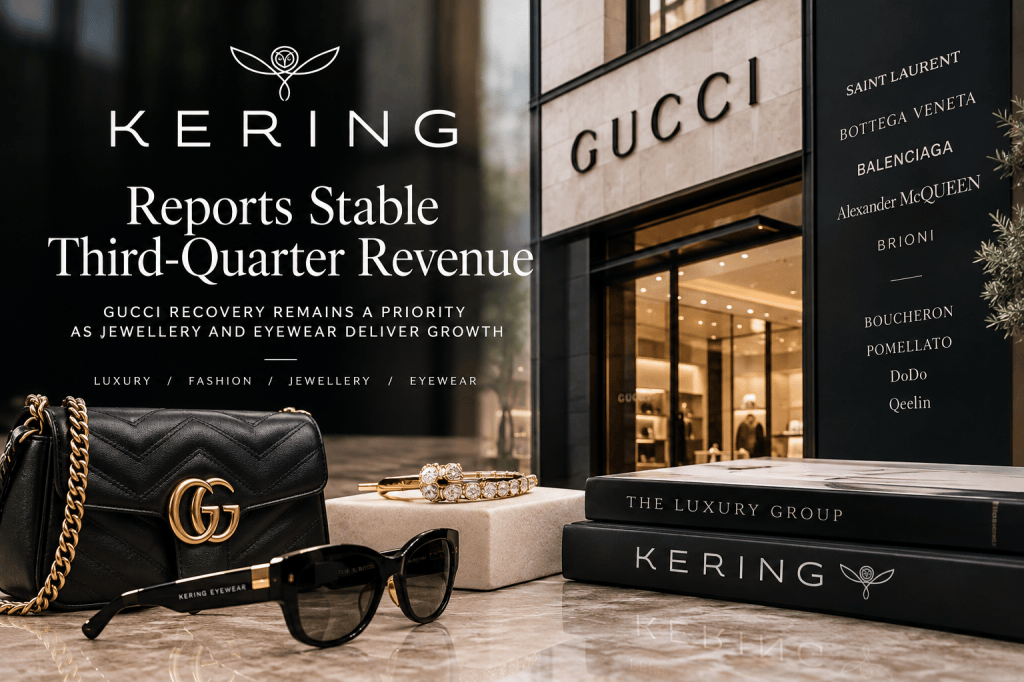
Luxury group records €3.35 billion in quarterly revenue as jewellery and eyewear deliver growth
Global luxury group Kering has reported third-quarter revenue of €3.345 billion, remaining stable compared with the same period last year on a reported basis, despite continuing challenges across the luxury fashion market.
The French luxury group, whose portfolio includes Gucci, Saint Laurent, Bottega Veneta, Balenciaga, Alexander McQueen and Brioni, recorded a 1% decline in revenue on a comparable basis for the three months. Kering attributed the performance to a softer economic environment, the timing of sales during the second half of the year and a more demanding comparison with the previous year.
The results highlight a mixed picture for the luxury sector, with some of Kering’s brands demonstrating encouraging momentum while Gucci continues to face pressure on sales.
Gucci Recovery Remains Central to Kering’s Strategy
Gucci generated revenue of €1.291 billion during the third quarter, representing a 4% decline on a reported basis and a 6% fall on a comparable basis.
The brand’s directly operated retail sales, including its own stores and online channels, declined by 9% on a comparable basis. Kering identified lower customer traffic as a significant challenge, particularly in Asia-Pacific, including mainland China, and Japan.
North America proved more resilient, although the brand also faced a tougher comparison with the previous year.
Kering is continuing to focus on improving Gucci’s product offering, strengthening product quality and refining its pricing and distribution strategy. Handbags remain a key priority, alongside further development in ready-to-wear clothing and footwear.
Wholesale revenue for Gucci increased significantly during the quarter, rising 35% on a comparable basis. However, this growth was partly influenced by a low comparison base and the timing of orders for new collections.
The figures underline the importance of restoring Gucci’s appeal and improving its retail performance as Kering works towards a broader recovery.
Saint Laurent and Bottega Veneta Show Resilience
While Gucci continues to experience difficulties, other fashion houses within the Kering portfolio delivered more encouraging performances.
Saint Laurent benefited from sustained demand in North America and Western Europe, alongside strong engagement from its established and core customer groups.
Bottega Veneta also performed well across key markets. Its results were supported by continued demand for leather goods, successful product launches and efforts to expand its ready-to-wear offering.
Brioni maintained strong growth, supported by its personalised customer relationships and bespoke tailoring services.
Balenciaga remained resilient in leather goods, although its ready-to-wear and footwear categories continued to face challenges. Alexander McQueen, meanwhile, is pursuing a repositioning strategy focused on its British tailoring heritage, product development and a more streamlined distribution network.
Across Kering’s Fashion and Leather Goods division, revenue reached €2.743 billion, down 1% on a reported basis and 3% on a comparable basis.
Excluding Gucci, directly operated retail sales across the division increased by 2%, illustrating the contrasting performances of the group’s individual brands.
Jewellery Emerges as a Growth Area
Kering’s jewellery division delivered one of the strongest performances in the third quarter.
Revenue reached €239 million, increasing by 12% on a reported basis and 11% on a comparable basis.
Boucheron benefited from demand for established collections, including Quatre and Serpent Bohème, while Pomellato continued to build momentum, particularly in Japan.
The performance of DoDo and Qeelin was more mixed, although both brands continued developing their product offerings.
Directly operated retail sales across the jewellery division increased by 18% on both reported and comparable bases. Wholesale and other revenue declined by 6%.
The results suggest that jewellery is becoming an increasingly important contributor to Kering’s wider portfolio, helping to offset some of the difficulties experienced in parts of its fashion business.
Kering Eyewear Continues to Grow
Kering Eyewear also reported positive results, with third-quarter revenue reaching €373 million.
This represented a 6% increase on a reported basis and 4% growth on a comparable basis.
The company attributed the performance to product innovation, commercial execution and growth across all regions. Developments during the quarter included the launch of Maui Jim’s autumn/winter 2026 collection and initiatives marking the 40th anniversary of Lindberg.
The eyewear division’s performance reinforces the importance of diversification within the luxury market, where businesses can draw revenue from categories beyond clothing, handbags and traditional fashion accessories.
Store Network Restructuring Continues
Alongside its efforts to strengthen individual brands, Kering is continuing to reshape its retail network.
During the first nine months of 2026, the group completed 105 net store closures, comprising 128 closures and 23 openings. This exceeded its original full-year objective of 100 net closures ahead of schedule.
Kering has now set a target of at least 125 net store closures for the full year.
The strategy reflects the group’s focus on improving the quality and efficiency of its retail operations rather than simply maintaining the size of its store network.
For the first nine months of 2026, total group revenue amounted to €10.565 billion, down 2% on a reported basis but stable on a comparable basis.
A Challenging Environment for Luxury
Kering’s latest figures reflect a luxury market in which brand desirability, customer engagement, product development and regional demand remain important factors in determining performance.
The group continues to face pressure from softer macroeconomic conditions and reduced customer traffic in some markets. However, the contrasting performances of its fashion, jewellery and eyewear businesses demonstrate that conditions vary considerably across luxury categories.
Kering has maintained its objective of improving its recurring operating margin in 2026, supported by efficiency measures while continuing to invest in its brands.
The group’s longer-term strategy centres on restoring Gucci’s momentum, strengthening its other fashion houses and making better use of its shared business operations.
What the Results Mean for the Luxury Industry
Kering’s third-quarter performance illustrates the importance of balancing heritage and brand recognition with product innovation, changing consumer expectations and careful financial management.
Although the group’s overall revenue remained broadly stable, Gucci’s decline demonstrates that even an internationally recognised luxury brand can face challenges when customer demand weakens.
Meanwhile, growth in jewellery and eyewear highlights the potential value of a diversified portfolio.
For the wider luxury industry, the coming quarters will provide further evidence of whether renewed product strategies, retail restructuring and improved customer engagement can translate into sustained growth.
Source: Kering, Revenue for the 3rd Quarter of 2026, published 22 October 2026.







Leave a Reply