What are five simple exercises to do at home?
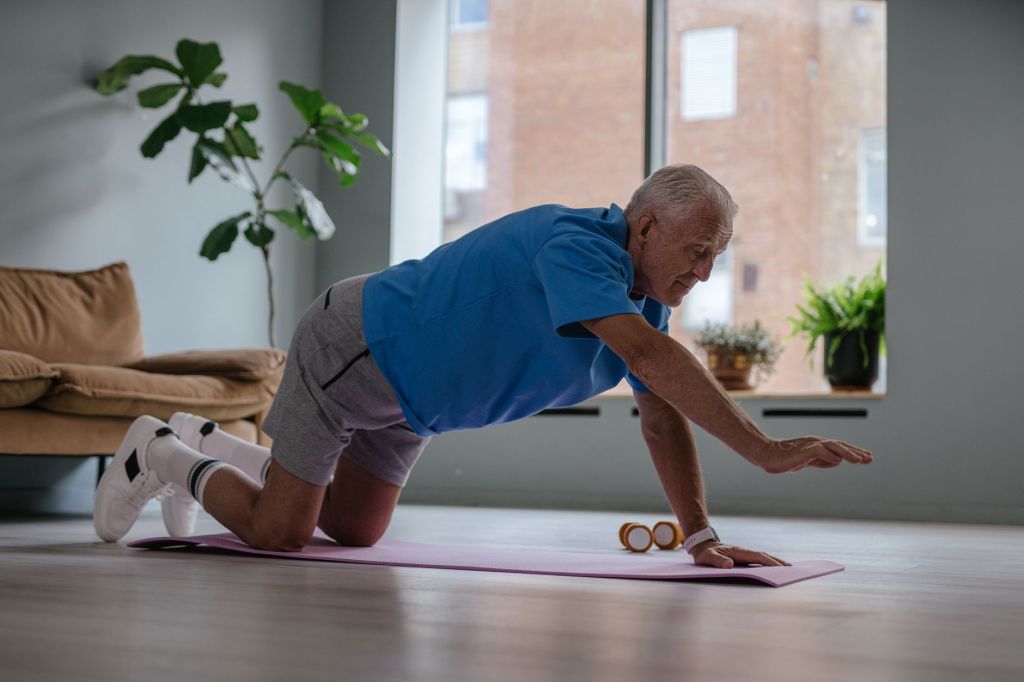
Staying active does not necessarily require a gym membership, expensive equipment or a large home workout space. Many effective forms of exercise can be performed at home using nothing more than your own body weight and a small amount of floor space.
Regular physical activity can support cardiovascular health, muscle strength, mobility and overall wellbeing. For people looking to become more active without making a significant financial commitment, simple home exercises can provide an accessible starting point.
Here are five exercises that can be incorporated into a basic home workout.
1. Squats
Squats are a simple bodyweight exercise that primarily works the muscles of the legs and hips, including the quadriceps, hamstrings and glutes.
To perform a basic squat, stand with your feet approximately shoulder-width apart. Keeping your back in a comfortable neutral position, bend your knees and lower your hips as though you are sitting into a chair. Return to the standing position and repeat.
Beginners can use a sturdy chair for support or practise sitting down and standing up from a chair.
2. Wall Push-Ups
Traditional push-ups can be challenging for beginners, but wall push-ups provide a simpler alternative.
Stand facing a wall and place your hands against it at approximately chest height. Slowly bend your elbows and lean your body towards the wall before pushing yourself back to the starting position.
Wall push-ups work the chest, shoulders and arms while placing less demand on the body than a standard floor push-up.
As strength improves, the exercise can be progressed by using a sturdy table or other stable elevated surface before eventually attempting conventional push-ups.
3. Glute Bridges
Glute bridges can be performed on the floor and require no equipment. They primarily target the gluteal muscles while also involving other muscles around the hips and core.
Lie on your back with your knees bent and your feet flat on the floor. Keeping your shoulders and upper back on the floor, lift your hips towards the ceiling. Pause briefly before lowering your hips in a controlled manner.
The movement can be performed slowly and deliberately, making it suitable for a basic home exercise routine.
4. Step-Ups
If you have access to a stable, secure set of stairs, step-ups can provide a straightforward way of incorporating cardiovascular and lower-body exercise into a home routine.
Step onto the first stair with one foot, bring the other foot up, then step back down in a controlled manner. Alternate the leading leg where comfortable.
Safety is important. The step or stair should be stable, dry and free from obstacles. Anyone who feels unsteady should avoid using stairs for exercise and choose a safer alternative.
5. Marching on the Spot
Marching on the spot is one of the simplest ways to increase movement without any equipment.
Stand upright and alternate lifting your knees while moving your arms naturally. The pace can be adjusted according to your fitness level.
A gentle march can be used as a warm-up, while increasing the pace can provide a more demanding cardiovascular workout.
Building a Simple Home Workout
These exercises can be combined into a short routine. For example, beginners could start with a small number of repetitions for each strength exercise and a short period of marching, taking rest breaks when necessary.
The key is consistency rather than trying to do too much at once. As fitness improves, repetitions, duration or the number of rounds can gradually be increased.
It is also important to remember that exercise ability varies considerably between individuals. People who are new to exercise, have an existing medical condition, have an injury or have concerns about their ability to exercise should consider speaking with a healthcare professional before starting a new routine.
Exercise Doesn’t Have to Be Expensive
One of the biggest advantages of bodyweight exercise is its accessibility. Squats, wall push-ups, glute bridges and marching require little or no equipment, while step-ups can make use of an existing safe household feature.
For many people, the most important piece of equipment is simply the decision to start moving more regularly.
A home workout does not have to be complicated or expensive to be useful. With a small amount of space, sensible progression and consistency, everyday movement can become part of a sustainable approach to fitness and wellbeing.









Leave a Reply