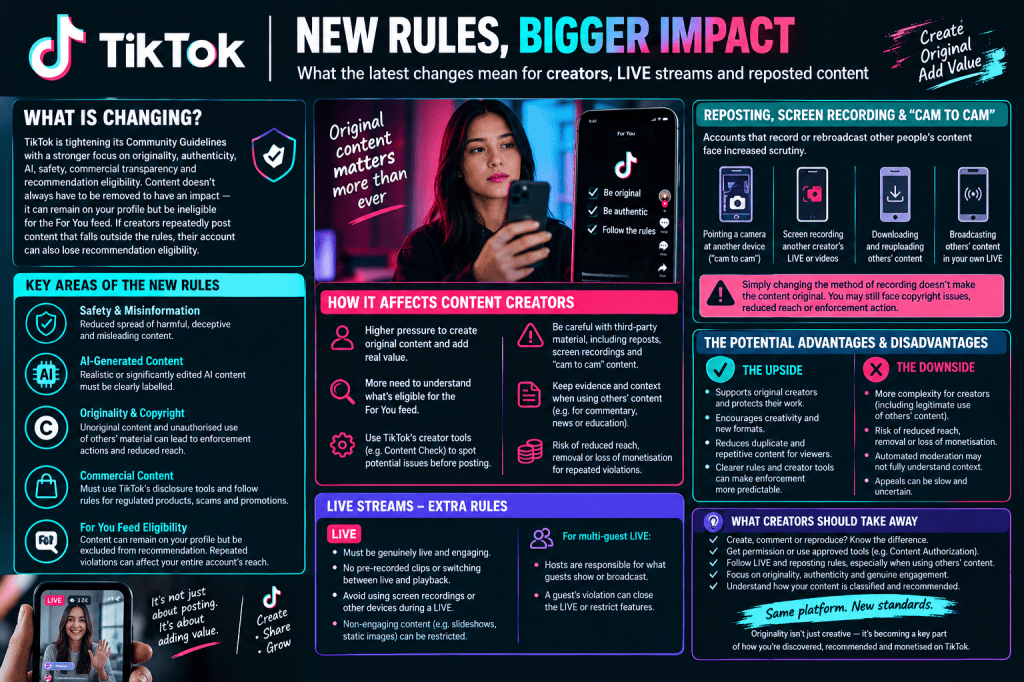
TikTok is continuing to tighten and clarify the rules governing content on its platform, with increasing emphasis on originality, authenticity, artificial intelligence, safety, commercial transparency and the way content is recommended to users.
For TikTok creators, the changes are particularly important because a post does not necessarily have to be deleted to have an impact on an account. Content can remain available on a creator’s profile while being made ineligible for recommendation through the For You feed. TikTok has also introduced measures that can restrict an entire account’s recommendation eligibility when creators repeatedly post material that falls outside its recommendation standards.
The changes could therefore have consequences for everyone from established influencers and TikTok Shop sellers to smaller creators, reaction accounts and users who record or rebroadcast other people’s content.
What is changing?
TikTok’s updated Community Guidelines bring greater clarity to existing policies while strengthening rules in several areas, including misinformation, artificial intelligence-generated material, unoriginal content, regulated goods, commercial activity and account behaviour.
TikTok says the updated guidelines were designed to make its rules clearer and easier to understand. The company has also expanded the sections covering features such as LIVE and TikTok Shop and says it is investing heavily in automated moderation. TikTok reported that more than 85% of content removed for Community Guidelines violations was being identified through automation.
For creators, this means that understanding TikTok’s policies is becoming increasingly important rather than simply relying on whether a video appears to be acceptable when it is uploaded.
Original content is becoming increasingly important
TikTok has placed considerable emphasis on original content.
Its Creator Rewards Program, for example, is designed to reward high-quality original videos longer than one minute, with originality forming one of the four principal factors in its rewards formula alongside play duration, search value and audience engagement.
This has wider implications for creators who build accounts around reposting material produced by somebody else.
TikTok’s published policies describe unoriginal content as material that a creator did not create themselves or does not have the appropriate rights to use. Examples include uploading material from other creators or other sources without the necessary permission.
Simply adding a watermark, logo or minor visual alteration does not necessarily make copied material original. TikTok’s published guidance specifically warns that superficial changes designed to disguise copied or repetitive content can still result in enforcement.
The For You feed is a major part of the issue
One of the most important distinctions for creators is the difference between being allowed to remain on TikTok and being eligible for recommendation.
TikTok operates separate eligibility standards for the For You feed. Content that does not meet those standards can remain on a creator’s profile without being recommended to a broad audience.
TikTok has also stated that accounts repeatedly posting content that violates its For You recommendation standards can temporarily become ineligible for recommendation themselves, making both the account and its content harder to find through search. Creators are notified and can appeal such restrictions.
For creators who depend on algorithmic discovery, this can be significant.
A video does not necessarily have to disappear completely for its reach to be affected.
What does this mean for content creators?
Creators increasingly need to consider several factors before publishing.
They may need to:
- Make sure content is genuinely original or that they have permission to use third-party material.
- Properly label realistic AI-generated or significantly altered content where required.
- Avoid artificial engagement and attempts to manipulate TikTok’s systems.
- Disclose commercial relationships and promotional content.
- Understand whether content is eligible for the For You feed.
- Pay attention to TikTok notifications concerning restrictions and enforcement.
- Use TikTok’s available creator tools to understand potential policy issues before publishing.
- Keep appropriate evidence when producing commentary, reporting, documentary or educational material involving third-party content.
The changes do not mean that commentary, criticism, reaction videos or discussion of other people’s work automatically become prohibited. The important question is increasingly what the creator is actually adding to the material and whether the use complies with TikTok’s rules and applicable copyright law.
LIVE streams face additional considerations
TikTok LIVE has its own set of requirements, and the platform has been increasingly specific about what constitutes acceptable LIVE content.
TikTok says LIVE content should be genuinely live and engaging. Its creator guidance warns against using pre-recorded material, switching between LIVE broadcasting and playback of pre-recorded clips, and using recordings of electronic-device screens as part of a LIVE.
TikTok’s UK creator guidance also addresses non-engaging livestreams, including broadcasts that rely heavily on static images, slideshows or other material rather than real-time interaction.
This could have particular significance for accounts that use another device to display somebody else’s content during a LIVE.
What about accounts that “cam” another account?
One increasingly visible practice involves a creator pointing a camera or phone at another phone, computer or television displaying somebody else’s TikTok LIVE.
Although the physical method of capturing the material may be different from a conventional screen recording, it does not automatically make the underlying material original.
TikTok’s published guidance for reproduced content specifically states that livestreams should not use content from other creators, pre-recorded content or content being played from another device. It also specifically tells creators not to use screen recordings or recordings of electronic-device screens as part of livestreams.
That means an account that simply points a camera at another creator’s LIVE could face questions about whether it is providing an original LIVE experience or simply reproducing somebody else’s content.
The important point is that changing the method of recording does not necessarily change ownership or originality.
Screen-recording another creator’s LIVE
The same principle applies to screen-recorded videos.
An account that records another creator’s LIVE and subsequently uploads the recording to its own profile may encounter issues surrounding unoriginal content, copyright and recommendation eligibility.
TikTok’s published guidance says short-form content should be created by the person posting it or use material they have the appropriate rights to use. Its current TikTok Shop guidance specifically identifies uploading content from other creators without permission as unoriginal content.
However, there is an important distinction between reposting and commentary.
A creator who uploads an entire LIVE with little or no original contribution is doing something substantially different from a creator who uses a limited section of somebody else’s material as part of genuine criticism, commentary, reporting, education or analysis.
That does not automatically make the latter permissible in every circumstance. Copyright law and TikTok’s policies still apply, and individual cases can depend on the circumstances.
Reaction accounts are not necessarily the same as repost accounts
Reaction and commentary creators occupy a more complicated position.
A creator who watches another person’s content and provides substantial original commentary, criticism, analysis or entertainment is contributing something of their own.
By contrast, an account that simply rebroadcasts another person’s LIVE, records it and uploads the recording with minimal additional material may have a much harder time demonstrating that the resulting content is genuinely original.
The distinction is therefore not necessarily whether somebody else’s content appears in the video. It is also about how the third-party material is being used and what the creator contributes.
What happens if creators repeatedly post unoriginal material?
The consequences can vary.
Depending on the circumstances, TikTok can remove content, restrict its recommendation, issue enforcement actions or impose restrictions on particular features.
TikTok has previously stated that repeated violations of its recommendation standards can result in an account becoming temporarily ineligible for recommendation, with its content and profile becoming harder to discover through search.
For TikTok Shop creators, TikTok’s current policy material also identifies consequences for unoriginal content that can include enforcement actions and loss of traffic or platform recommendation for violating content.
This is particularly relevant to creators who rely on TikTok for income.
LIVE monetisation could also be affected
LIVE is not simply an entertainment feature. For many creators, it is an important source of income.
TikTok has previously introduced LIVE Monetization Guidelines covering content that is inauthentic, low quality or otherwise unsuitable for monetisation. Violations can result in restrictions on access to LIVE monetisation features.
Consequently, creators using reproduced or low-engagement material during LIVE broadcasts may face more than just reduced visibility.
For creators who depend on gifts, subscriptions, TikTok Shop activity or other monetisation opportunities, restrictions can potentially have a direct financial impact.
There can be advantages for original creators
The tightening of these rules could provide benefits for people who produce their own work.
Creators who invest time in filming, researching, editing and presenting original material may have greater protection against accounts simply copying their work and using it to build their own audiences.
TikTok’s emphasis on originality also encourages creators to develop their own formats, opinions, commentary and creative approaches rather than relying entirely on material produced by somebody else.
For audiences, reducing duplicated and repetitive material could also make it easier to find the person who originally created a piece of content.
There are also disadvantages and concerns
Stricter enforcement can create difficulties for legitimate creators.
News reporting, documentary work, criticism, education and commentary frequently involve discussing or displaying material originally produced by somebody else.
Automated moderation may not always understand the context surrounding a video, particularly when a creator is using third-party material for a legitimate purpose.
TikTok provides appeal mechanisms for creators who believe enforcement has been applied incorrectly, but the process can still create uncertainty for people whose livelihoods depend on consistent access to their audiences.
There is also the possibility that creators become more cautious about using third-party material, even when they believe their use is legitimate.
A particular warning for “copy-and-post” accounts
Accounts built around finding another creator’s LIVE, recording it and then uploading the footage to their own profile may face increasing pressure as TikTok strengthens its originality policies.
The same applies to accounts that:
- Record another creator’s LIVE from a second phone.
- Point a camera at another person’s phone or computer screen.
- Screen-record another account’s LIVE and repost it.
- Download another creator’s video and upload it as their own.
- Add a watermark or small visual alteration to copied material.
- Broadcast somebody else’s pre-recorded content through their own LIVE.
- Repeatedly repost material from other creators without meaningful original contribution.
TikTok’s current published guidance specifically identifies playing content from another device, using screen recordings during LIVE and broadcasting other creators’ content as examples of reproduced content in the TikTok Shop context.
For ordinary TikTok content, copyright and unoriginal-content policies can also apply.
Permission can make a difference
Permission is another important consideration.
TikTok Shop has introduced a Content Authorization Tool allowing eligible creators to request permission from another TikTok account to repost its content. The tool is designed to give creators a direct way of authorising content use between accounts.
However, permission to use content does not necessarily mean that every type of repost automatically becomes eligible for recommendation or monetisation. Creators still need to comply with the relevant TikTok policies and applicable law.
The bigger change for TikTok creators
TikTok’s evolving rules represent a broader shift across social media.
Platforms are increasingly looking beyond whether a piece of content is technically uploaded successfully. They are also examining originality, authenticity, engagement, recommendation eligibility, copyright, commercial transparency and whether content provides genuine value to viewers.
For creators, that means understanding the platform is becoming almost as important as producing content.
The days when a creator could simply copy another account’s video, make a minor alteration and assume that the material had become their own are increasingly being challenged by platform policies.
What creators should take away
For anyone building an audience or income on TikTok, the safest approach is to understand the distinction between creating, commenting and reproducing.
Original videos, genuine LIVE interaction and meaningful commentary are fundamentally different from simply rebroadcasting somebody else’s work.
Creators using other people’s material should consider whether they have the necessary rights or permission, whether their use adds substantial original value and whether the content complies with TikTok’s current recommendation and monetisation policies.
For LIVE creators in particular, broadcasting another person’s content from a phone, computer or television screen should not be assumed to qualify as an original LIVE simply because the creator is physically holding a camera.
TikTok’s changing creator economy
TikTok remains one of the world’s most important platforms for creators, but its creator economy is becoming increasingly regulated by platform rules.
The changes bring potential benefits for original creators and audiences, while also creating additional responsibilities and uncertainty for creators who rely on third-party material.
The most important distinction going forward may be between being allowed to upload something and being rewarded with distribution, visibility and monetisation.
For creators, originality is no longer simply a creative principle. It is increasingly becoming an important part of how content is discovered, recommended and potentially monetised on TikTok.









Leave a Reply