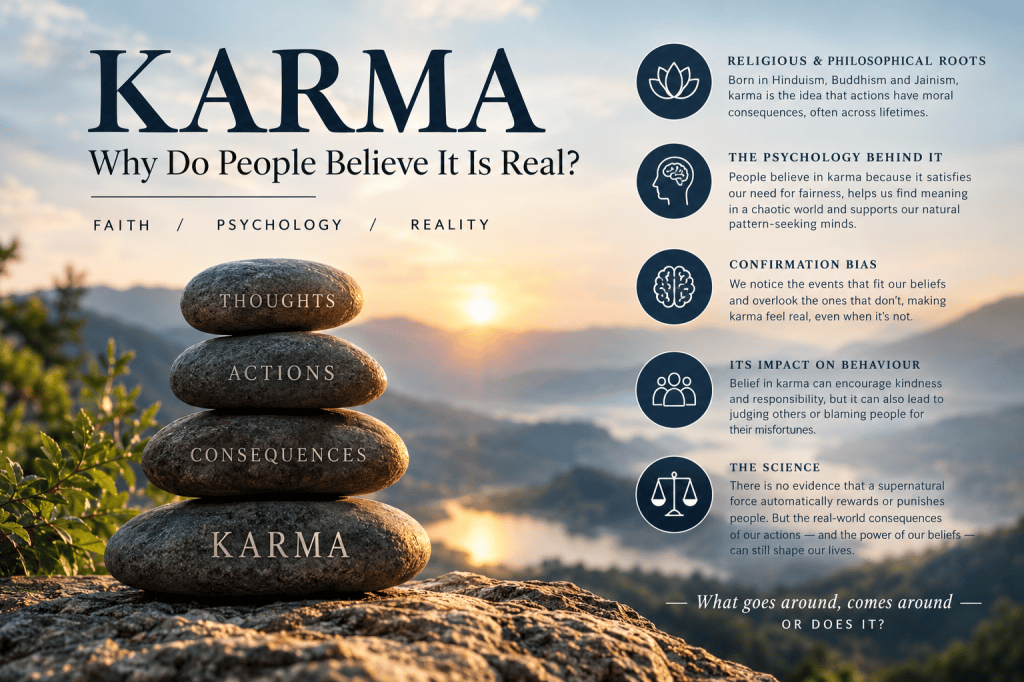
Do you believe in karma?
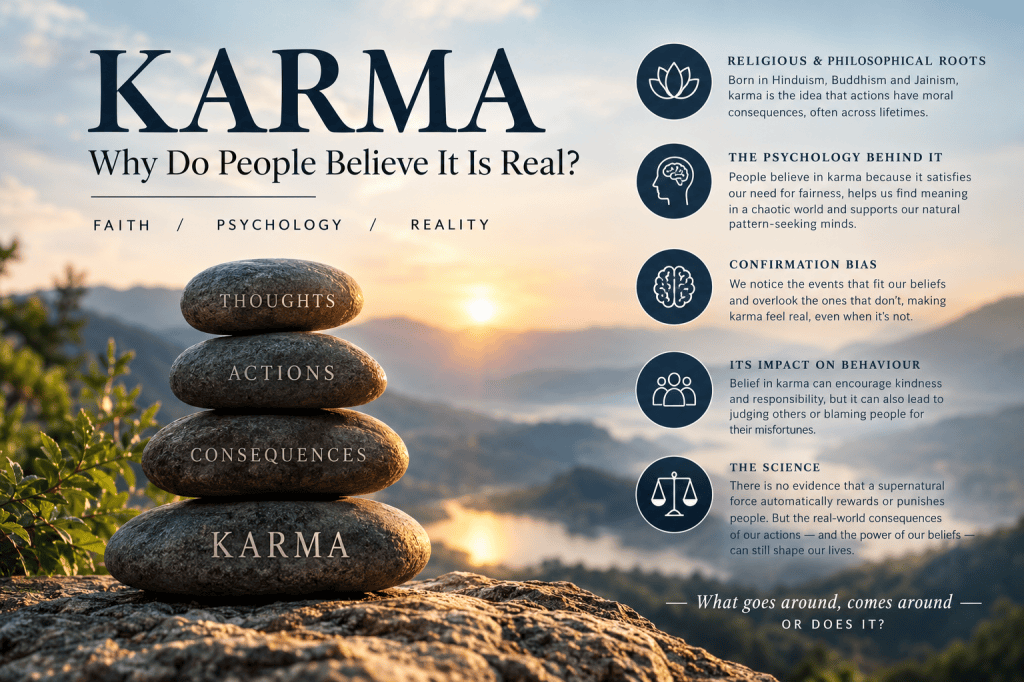
The idea of karma has become part of everyday language. People often use the word to describe the belief that good actions eventually lead to positive consequences, while harmful or dishonest behaviour eventually comes back to the person responsible. But the traditional concept of karma is considerably more complex than the popular phrase “what goes around comes around.”
Karma has its origins in the religious and philosophical traditions of India. The Sanskrit word karman broadly means “act” or “action”. In Hinduism, Buddhism and Jainism, karma developed into different but related ideas concerning the moral consequences of actions. In many traditions, karma is connected to rebirth, with actions influencing future experiences across one or more lifetimes.
Modern popular culture often treats karma as an almost automatic form of cosmic justice. Someone behaves badly and, sooner or later, something unfortunate happens to them. Conversely, someone who behaves generously may appear to receive good fortune. While this interpretation is widespread, science has not established karma as a supernatural force that objectively rewards or punishes people.
Psychology, however, offers several explanations for why the idea can feel very real.
The Human Desire for a Just World
One important concept in psychology is known as the “belief in a just world.” This describes the tendency to believe that people generally get what they deserve: good behaviour should produce positive outcomes and bad behaviour should eventually produce negative ones.
Research into just-world beliefs has found that people can interpret events according to ideas of deservingness. For example, when a person’s behaviour appears morally good, people may be more inclined to see a positive outcome as deserved. The same process can operate in reverse when someone perceived as bad experiences misfortune.
Karma provides a particularly powerful framework for this kind of thinking because it offers an explanation for situations in which ordinary justice appears to have failed.
A person may escape punishment for something they have done, leaving observers with the uncomfortable feeling that the world is unfair. Belief in karma can provide another possible explanation: justice may simply take longer to arrive.
Pattern Recognition and Meaning
Human beings are naturally inclined to search for connections between events. This is useful because recognising genuine cause and effect helps us understand and navigate the world.
However, the same tendency can sometimes lead people to connect events that are not actually causally related.
Someone might behave badly towards another person and subsequently experience a completely unrelated setback. If the observer already believes in karma, the two events may be interpreted as connected.
Psychological research suggests that beliefs in supernatural justice can be supported by people’s desire to make sense of uncertain events and maintain a feeling that the world has meaning and order.
Confirmation Bias
Another possible explanation is confirmation bias — the tendency to pay greater attention to information that supports an existing belief while giving less attention to information that contradicts it.
Imagine someone believes strongly in karma. If a dishonest person later experiences a setback, the event may stand out as evidence that karma works. Hundreds of occasions when dishonest people experience ordinary good fortune may receive much less attention.
This does not necessarily mean that someone is deliberately ignoring reality. Selective attention and memory can happen without conscious intention.
The result can be a collection of personal experiences that appear to confirm the belief.
Why Karma Can Feel Personal
Research specifically examining beliefs about karma has found that they are associated with, but are not identical to, beliefs in a just world, religious belief and cultural background. A large cross-cultural study involving 8,996 participants from Canada, India and the United States found that belief in karma was also associated with distinctive ways of explaining misfortune.
This helps explain why karma can become more than an abstract religious concept. It can become part of the way an individual interprets everyday experiences.
If something positive happens after a person has behaved generously, they may regard it as evidence that their actions have produced good karma. If something negative happens after someone has behaved badly, the event may be interpreted as karmic consequences.
Karma Can Influence Behaviour
Belief in karma is not necessarily associated only with passive acceptance of fate. Psychological research suggests that karma-related beliefs can influence social behaviour.
A recent review of research found evidence that thinking about karma can sometimes encourage prosocial behaviour, generosity and reduced desire for revenge. At the same time, researchers have identified potential negative consequences, including blaming people for their misfortunes or interpreting suffering as something that a person somehow deserves.
This is an important distinction.
Believing that actions have consequences can encourage people to behave responsibly. But assuming that every unfortunate event is deserved can lead to unfair conclusions about people who have experienced circumstances beyond their control.
Does Karma Actually Work?
This is where the distinction between belief and scientific evidence becomes important.
There is currently no established scientific evidence demonstrating that a supernatural force called karma automatically rewards good behaviour or punishes bad behaviour.
That does not make the belief meaningless to the people who hold it. Religious and spiritual beliefs can influence behaviour, values, expectations and interpretations of events even when their supernatural claims cannot be tested scientifically.
There are also ordinary forms of “karma” that can occur without anything supernatural taking place.
A person who consistently treats others with respect may develop stronger relationships, greater trust and a better reputation. Someone who repeatedly lies or exploits people may eventually lose relationships, employment opportunities or social trust.
Those consequences can look like karma, but they can also be explained through ordinary social cause and effect.
The Psychology of “What Goes Around Comes Around”
The popularity of karma may therefore reflect several overlapping aspects of human psychology: our desire for fairness, our search for patterns, our need to explain uncertainty and our tendency to remember events that fit our existing beliefs.
There is also a social dimension. Expectations of reciprocity — the idea that people should return kindness, generosity or cooperation — are important in human relationships. Research has found relationships between just-world beliefs and reciprocal behaviour in experimental settings.
In everyday life, therefore, some experiences described as karma may simply be the consequences of social behaviour unfolding over time.
A Belief With Two Very Different Interpretations
Karma occupies an unusual position between religion, philosophy, culture and psychology.
For millions of people, it remains a genuine spiritual principle concerning moral action and its consequences. For others, it is a useful metaphor for the ordinary consequences of behaviour. And from a psychological perspective, the feeling that karma is operating may partly arise from powerful human tendencies to seek fairness, meaning and connections between events.
The belief that “what goes around comes around” cannot, by itself, establish that a supernatural force is controlling events.
But the persistence of the idea tells us something significant about human psychology: people have a powerful desire to believe that actions matter, that behaviour has consequences and that, ultimately, the world makes some kind of moral sense.
Whether someone understands karma as a spiritual law, a philosophical principle or simply a description of social cause and effect, its enduring appeal lies in one remarkably persistent human question: Does the way we behave eventually come back to us?









Leave a Reply