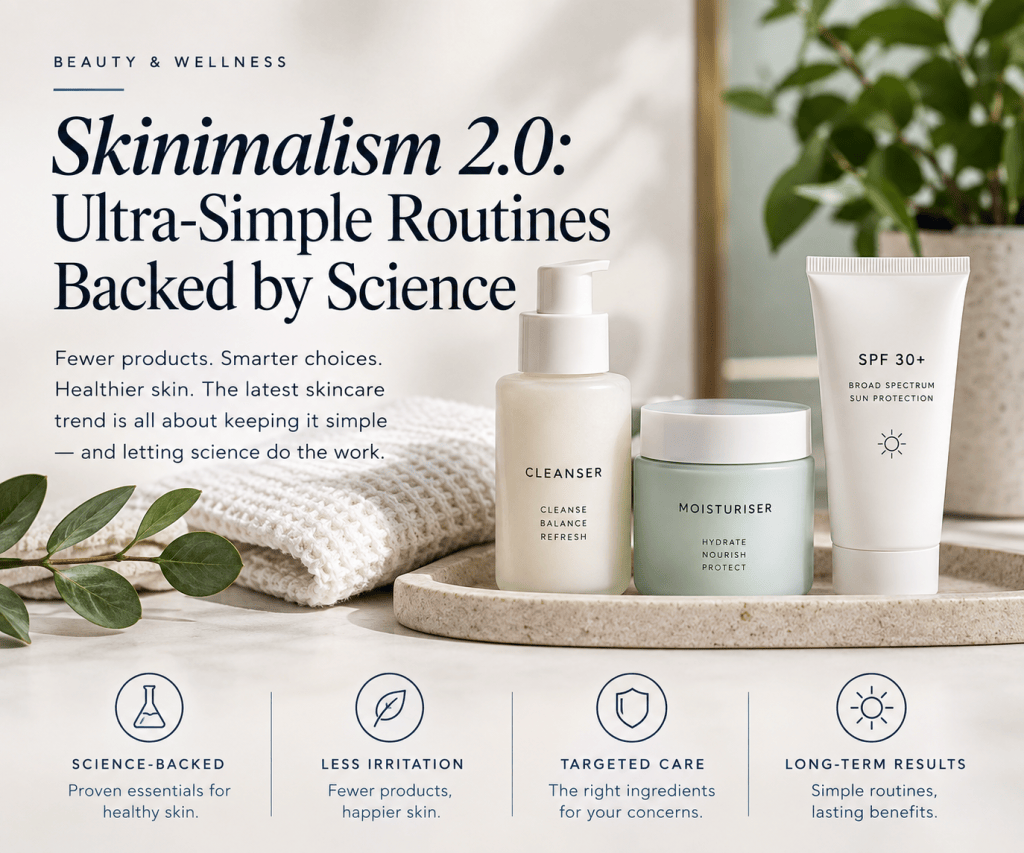
The latest approach to skincare is less about having more products and more about understanding what skin actually needs.
For years, skincare routines have become increasingly elaborate, with multiple cleansers, toners, essences, serums, exfoliants, masks and treatments competing for space on bathroom shelves. Now, a simpler approach is gaining attention: Skinimalism 2.0.
The idea is straightforward — use fewer products, concentrate on proven skincare fundamentals and avoid unnecessarily complicated routines.
While “skinimalism” is largely a beauty and lifestyle term rather than a medical treatment, its underlying principles are consistent with advice from dermatologists. The American Academy of Dermatology (AAD) recommends a basic approach centred on cleansing, moisturising and protecting the skin from the sun.
The three-step foundation
For many people, an effective routine can begin with just three essentials: a gentle cleanser, a moisturiser and broad-spectrum sunscreen.
A gentle cleanser can remove dirt, excess oil and other debris without unnecessarily irritating the skin. Dermatologists advise avoiding aggressive scrubbing and recommend limiting facial washing to twice a day and after heavy sweating.
Moisturiser has another important role. Rather than simply making skin feel softer, it helps reduce water loss and supports the skin’s moisture barrier. Applying moisturiser to slightly damp skin can help trap water in the skin.
Then there is sunscreen — arguably the most important daytime step. Dermatologists recommend broad-spectrum sunscreen with an SPF of 30 or higher, alongside other sun-protection measures such as shade and protective clothing. Regular protection helps reduce ultraviolet-related skin damage, including premature ageing and skin-cancer risk.
Fewer products can mean less irritation
A minimalist routine does not mean that every additional skincare product is unnecessary. Instead, the principle is to introduce products because there is a specific reason for using them.
The AAD warns that using too many products, particularly several anti-ageing products at once, can irritate the skin. Introducing multiple new products simultaneously can also make it difficult to determine which product is responsible if irritation develops.
This is particularly relevant as social media continues to influence skincare habits. Dermatologists have cautioned that viral routines are not automatically appropriate for every skin type, and excessive use of products can contribute to irritation, clogged pores and breakouts.
The targeted-treatment approach
Skinimalism 2.0 does not necessarily mean abandoning active ingredients. Instead, the emphasis is on choosing an ingredient according to an identifiable skin concern.
For example, dermatologists may recommend ingredients such as salicylic acid or benzoyl peroxide for acne, while retinoids can be used for concerns including acne, uneven pigmentation, skin texture and fine lines. Vitamin C is another ingredient commonly used for pigmentation and signs of skin ageing.
The key is not to introduce everything at once.
A simpler routine might therefore look like this:
Morning: gentle cleanse if needed, moisturiser if required, followed by broad-spectrum SPF 30 or higher.
Evening: gentle cleanser, moisturiser and, if appropriate, one targeted treatment.
The exact routine should depend on individual skin type, concerns and tolerance.
The science behind simplicity
The appeal of Skinimalism 2.0 is not simply aesthetic. Consistency is an important part of skincare.
A complicated routine may look impressive, but if it causes irritation or becomes too difficult to maintain, its practical value can be limited. Dermatologists emphasise that skincare should be tailored to individual needs and that products should be given sufficient time to demonstrate whether they are useful.
For people with oily skin, for example, dermatologists still recommend moisturising rather than attempting to strip away all oil. Non-comedogenic products can be useful for people concerned about clogged pores, while harsh cleansing can actually irritate the skin.
A return to skin health
Perhaps the biggest change represented by Skinimalism 2.0 is a shift away from the idea that healthier-looking skin requires an ever-growing collection of products.
Instead, the emphasis is increasingly on maintaining the skin barrier, protecting against ultraviolet exposure and introducing targeted treatments only when there is a clear reason to do so.
That does not mean every person needs exactly the same three products. Dry, oily, acne-prone and sensitive skin can have very different requirements, and people with persistent or significant skin problems may need professional dermatological advice.
But the central message is increasingly straightforward: skincare does not have to be complicated to be considered effective.
In an industry built around constantly introducing the next product, Skinimalism 2.0 offers a different proposition — understand your skin, identify what it actually needs and build a routine that you can realistically maintain.









Leave a Reply