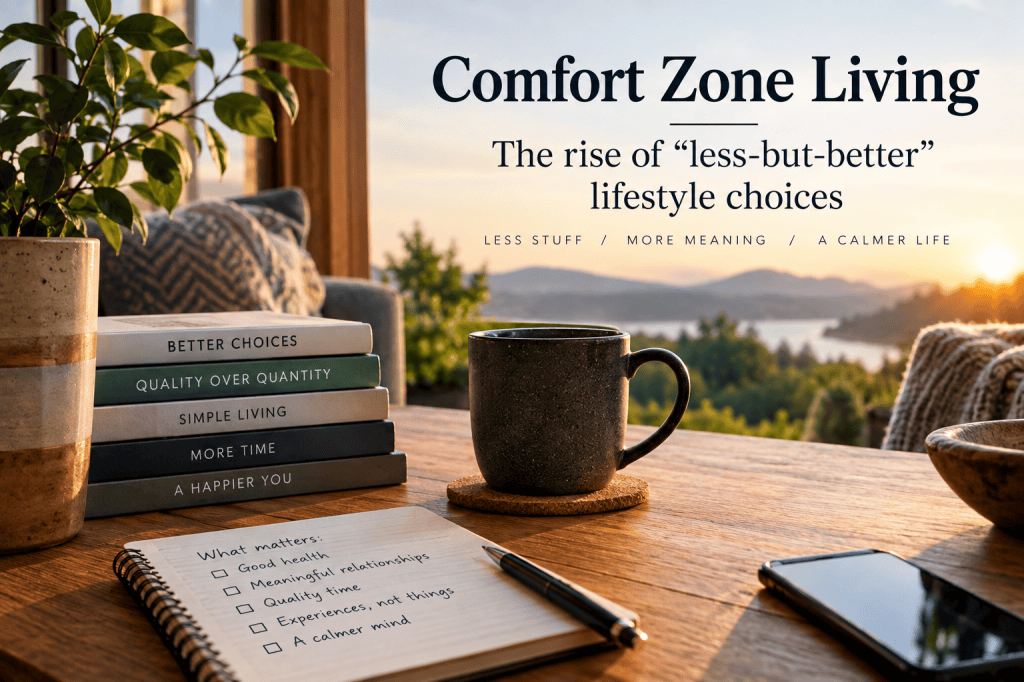
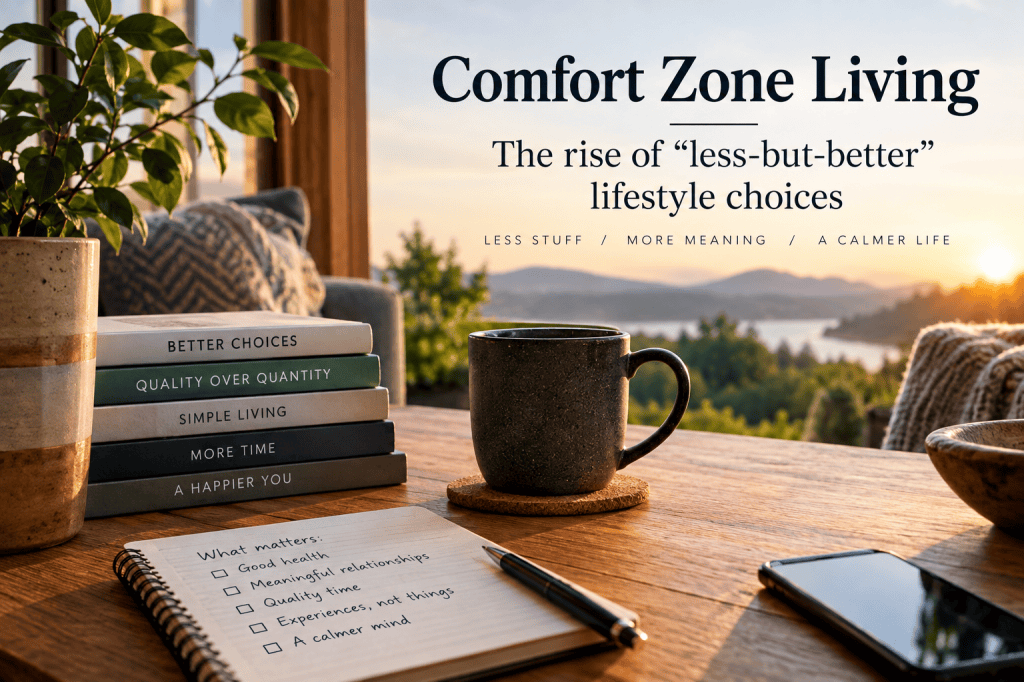
Modern life often encourages people to believe that more is better. More possessions, more commitments, more experiences, more technology and an increasingly busy schedule can all be presented as signs of success.
Yet a different approach is becoming increasingly visible: less-but-better living.
Rather than pursuing constant expansion, some people are choosing to simplify their surroundings, reduce unnecessary commitments and place greater value on comfort, quality and personal satisfaction. It is not necessarily about minimalism or rejecting ambition. Instead, it is about becoming more selective about what deserves time, money, energy and attention.
What Does ‘Less-but-Better’ Mean?
The idea is relatively straightforward: instead of accumulating more simply because more is available, people make deliberate choices about what they actually need and value.
This can apply to almost every part of everyday life.
Someone might buy fewer clothes but choose better-quality garments that last longer. Another person might prefer one carefully selected holiday rather than several expensive trips. Someone else might reduce their social commitments in favour of spending more time with close friends and family.
The principle is not necessarily about spending less money. In some circumstances, choosing quality over quantity can actually cost more initially. The difference is that the purchase is intended to be more useful, durable or meaningful.
The Appeal of Comfort
Comfort has traditionally been associated with material possessions, but comfort-zone living can mean much more than having a comfortable sofa or a well-designed home.
It can involve creating an environment where people feel relaxed and in control of their time.
For some, that might mean enjoying a quiet evening at home rather than constantly going out. For others, it could mean maintaining a predictable routine, working from a comfortable environment, reading, cooking, exercising or simply having periods of uninterrupted time.
In a culture where busyness can sometimes be mistaken for productivity, deliberately making space for rest can be a meaningful lifestyle choice.
Quality Over Quantity
One of the central ideas behind less-but-better living is the distinction between ownership and value.
A wardrobe containing dozens of items does not necessarily provide more satisfaction than one containing a smaller number of well-chosen clothes. A bookshelf does not need hundreds of unread books to demonstrate an interest in reading. A kitchen does not need every available gadget if the owner regularly uses only a handful of essential tools.
The same principle can apply to technology.
Consumers are constantly presented with new phones, televisions, computers and other devices. However, replacing something simply because a newer version exists is not always necessary. Keeping a functioning product for longer can be a practical choice, particularly when the replacement offers only marginal improvements.
This is where less-but-better living overlaps with ideas such as durability, repair and responsible consumption.
Decluttering Without Becoming a Minimalist
Less-but-better living should not automatically be confused with extreme minimalism.
Minimalism can involve deliberately reducing possessions to a very small number. A less-but-better lifestyle can be much more flexible.
The objective is not necessarily to own as little as possible. It is to avoid allowing possessions, commitments and distractions to become excessive.
A person can still enjoy collecting books, owning clothes, decorating their home or pursuing hobbies while being selective about what they acquire.
The important question becomes:
Does this add genuine value to my life?
If the answer is yes, there is no inherent reason to remove it simply because somebody else considers it unnecessary.
Choosing Experiences Carefully
The idea can also extend beyond material possessions.
Modern culture frequently promotes the idea that people should constantly be doing something: travelling, attending events, dining out, networking or documenting experiences online.
But a meaningful life does not necessarily require a permanently full calendar.
There can be considerable value in choosing experiences carefully rather than trying to experience everything.
A quiet meal with people you care about, an afternoon reading a book, a walk, watching a favourite film or pursuing a hobby can be just as personally significant as a major event.
The concept of less-but-better therefore challenges the assumption that an interesting life must always be a busy one.
The Role of Technology
Technology has made modern life considerably more convenient, but it has also created new sources of distraction.
Smartphones, social media, notifications and streaming services provide an almost unlimited supply of information and entertainment. The challenge is not necessarily technology itself but how deliberately it is used.
Some people are responding by establishing clearer boundaries.
That might involve turning off unnecessary notifications, spending less time on social media, keeping phones away during meals or creating periods where digital devices are deliberately ignored.
The objective is not to reject technology. It is to make technology serve the individual rather than allowing every notification or online trend to dictate attention.
Financial Considerations
There is also a practical financial argument for being more selective.
Buying fewer unnecessary items can reduce expenditure, while investing in durable products can sometimes reduce the need for frequent replacement.
However, less-but-better should not be presented as a universal financial solution. Quality products can be expensive, and not everyone has the financial flexibility to prioritise them.
For many households, the most realistic version of the philosophy may simply be buying less impulsively.
Waiting before making a purchase, comparing products, considering how frequently something will be used and distinguishing between a genuine need and a temporary desire can all encourage more deliberate consumption.
The Importance of Personal Choice
Perhaps the most important aspect of comfort-zone living is that there is no single definition of what a good life should look like.
For one person, comfort may mean a quiet home and very few commitments.
For another, it might mean a busy family life, regular travel and an active social calendar.
Less-but-better is therefore not a competition to see who can own the fewest possessions or have the quietest lifestyle. It is about understanding personal priorities and making choices accordingly.
There is little value in adopting somebody else’s version of minimalism if it makes life less enjoyable.
Moving Away From Constant Consumption
The wider popularity of less-but-better thinking also reflects a broader conversation about consumer culture.
Advertising is designed to encourage people to buy. New products are continually introduced, trends change rapidly and social media can make other people’s lifestyles appear more desirable.
Being aware of these influences does not require rejecting consumerism entirely.
It simply creates an opportunity to pause and ask whether a purchase or commitment is genuinely wanted.
That small pause can sometimes make the difference between an intentional decision and an impulsive one.
A More Deliberate Definition of Success
Perhaps the most interesting aspect of comfort-zone living is that it challenges conventional ideas about success.
Success does not have to mean constantly acquiring more, working longer hours or maintaining an increasingly complicated lifestyle.
For some people, success may instead mean having enough.
Enough possessions.
Enough money to live comfortably.
Enough work to provide purpose and security.
Enough free time to enjoy life.
Enough meaningful relationships to feel connected.
That does not mean abandoning ambition. It means recognising that ambition and simplicity can coexist.
Less, But Better
The rise of less-but-better living is ultimately about intentionality.
It asks people to distinguish between what is genuinely valuable and what is simply available.
It encourages quality over unnecessary quantity, meaningful experiences over constant activity and deliberate choices over automatic consumption.
There is no requirement to become a minimalist, abandon modern technology or retreat from society.
Sometimes the simplest change is simply learning to say:
I don’t need more. I need what I already have to matter more.
In a culture that frequently tells us to want the next thing, there can be something powerful about being comfortable with enough.









Leave a Reply