The internet has created unprecedented opportunities for communication, gaming and social interaction. It has also created new environments in which criminals can identify vulnerable people, establish relationships with them and exploit those relationships from behind anonymous accounts.
One of the most serious examples currently being investigated internationally is a loose collection of online networks commonly associated with 764, sometimes referred to within wider online criminal communities as part of “The Com.”
The FBI has warned that 764 and related violent online networks systematically target minors and other vulnerable people through mainstream social media, gaming platforms and messaging applications. Investigators say victims can be manipulated into producing sexual material, self-harm material or other violent content, which can then be used for blackmail, intimidation and further exploitation.
The threat is not confined to one country or one website. Investigations have involved authorities in the United States, United Kingdom, Australia, New Zealand, Canada and other countries.
What is 764?
764 is not a conventional organisation with a clearly defined membership list, headquarters or traditional chain of command.
Instead, researchers and law-enforcement agencies describe a fluid collection of online actors, groups and offshoots that can appear, disappear and reform under different names.
The wider environment is often referred to as “The Com”, a term used for decentralised online criminal communities involved in activities including cybercrime, extortion, harassment and violent exploitation.
The FBI describes 764 and related networks as violent online networks. U.S. authorities have also used the term “nihilistic violent extremism” when describing some of the activity associated with these groups. Researchers have noted, however, that the individuals involved do not necessarily share a single coherent ideology or political programme. Motivations can include sexual exploitation, notoriety, status, control, entertainment and belonging.
This distinction is important because 764 should not be understood simply as a conventional extremist organisation. It is better understood as part of a constantly changing online ecosystem in which individuals and groups can cooperate, compete, imitate one another and move between platforms.
Who are the victims?
The available evidence shows that children and teenagers are particularly vulnerable.
The FBI states that victims are typically between 10 and 17 years old, although it has identified victims as young as nine. The agency also says that anyone can be targeted, including boys, girls, adults, males and females.
Research and law-enforcement data indicate that teenage girls make up a substantial proportion of identified victims.
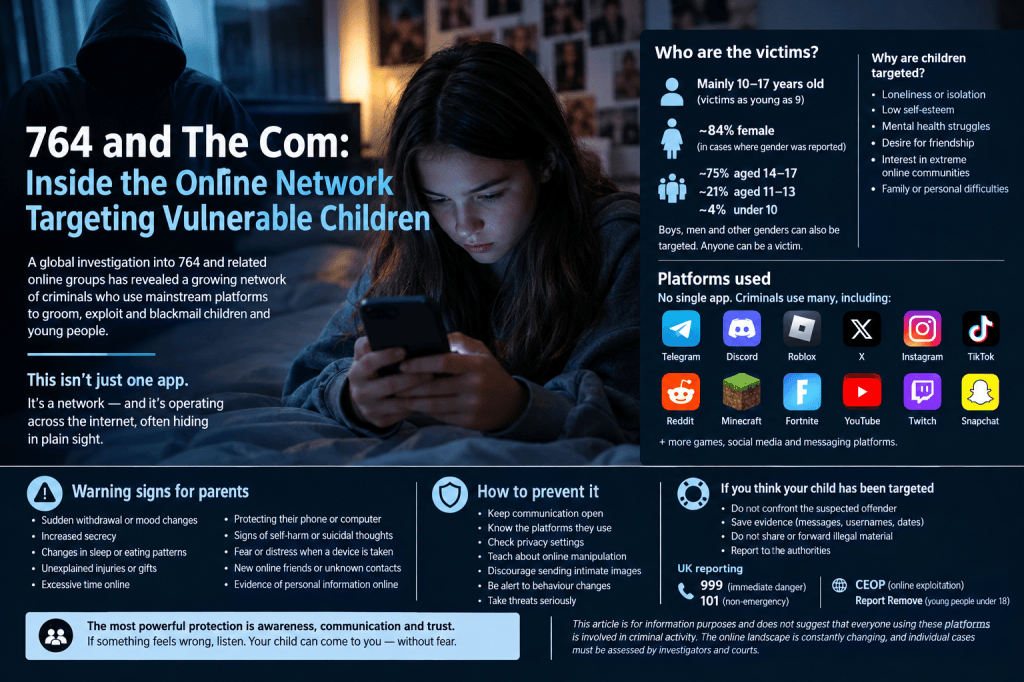
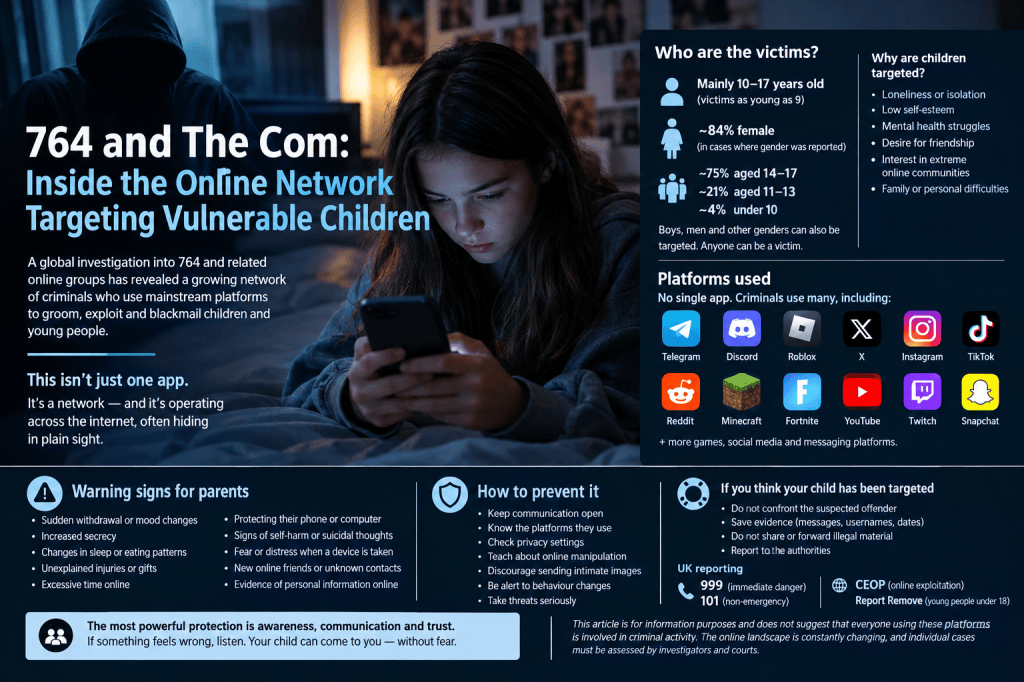
Data reported from the U.S. National Center for Missing & Exploited Children concerning violent online groups found that, among cases where age and gender were reported, approximately 84% of victims were female. Around 75% were aged 14–17, approximately 21% were 11–13, and approximately 4% were under 10. These figures should not be interpreted as a complete demographic profile of every 764 victim because reporting datasets do not capture every victim or every incident.
The FBI similarly warns that although perpetrators systematically target underage females, boys and men can also become victims.
The age profile is therefore particularly significant for parents. A child does not have to be an older teenager to be approached.
The FBI has reported cases involving children as young as nine, while other investigations have involved teenagers.
Why are children targeted?
The answer is not simply that children are using the internet.
Predators look for vulnerabilities.
These can include loneliness, isolation, low self-esteem, previous self-harm, family difficulties, a desire for friendship, an interest in extreme online communities or simply the normal desire of a teenager to be accepted by peers.
The FBI has specifically warned that vulnerable young people can be targeted because of circumstances including depression, eating disorders or suicidal thoughts.
However, it is important not to suggest that vulnerable children are responsible for what happens to them.
The responsibility belongs to the person carrying out the exploitation.
A child can enter an online conversation believing that they have found a friend, romantic interest or someone who understands them, only to discover that the relationship is being manipulated.
How the grooming process can work
Investigators have identified recurring patterns.
A perpetrator may initially appear friendly, sympathetic or interested in the victim’s hobbies.
The conversation can begin on an ordinary platform, including a social network or gaming service.
The perpetrator may then attempt to move the conversation somewhere more private.
Research by the Institute for Strategic Dialogue identified Discord and Telegram as particularly important spaces within the 764 ecosystem, while also identifying activity across a wide range of mainstream platforms.
The next stage can involve obtaining personal information, photographs or other material.
Once something compromising has been obtained, the relationship can change dramatically.
Threats may follow.
The victim may be told that material will be sent to parents, friends, teachers or other people unless further demands are met.
This creates a cycle of grooming, coercion, blackmail and escalating demands.
The FBI says perpetrators can use threats and blackmail to force victims into producing or livestreaming sexual material, self-harm, animal cruelty or other violent acts.
The platforms used
One of the most important facts for parents is that there is no single “764 app.”
Investigators have identified activity across numerous mainstream services.
Research by the Institute for Strategic Dialogue identified the following platforms in connection with 764 activity:
- Telegram
- Discord
- Roblox
- X
- TikTok
- Minecraft
- Fortnite
- YouTube
- Twitch
- Snapchat
- Other online games and smaller platforms
The organisation stressed that this list is not exhaustive and that networks associated with 764 continually adapt their methods and move between services.
Discord and Telegram have featured prominently in investigations.
Research indicates that Discord can be used for initial contact and communication, while Telegram has been particularly important for coordination and the sharing of material between participants.
Roblox has also appeared repeatedly in investigations because its enormous young user base provides opportunities for strangers to interact.
This does not mean that these platforms are inherently criminal or that ordinary users are involved in 764.
Millions of people use these services safely.
The problem is that criminals can exploit legitimate platforms for criminal purposes.
The importance of gaming platforms
The involvement of gaming environments deserves particular attention from parents.
A child may regard an online game as completely different from social media.
From a predator’s perspective, however, a game can provide an environment in which strangers can communicate naturally.
The FBI specifically warns that 764-related actors operate on gaming platforms as well as social media and mobile applications.
Researchers have documented approaches involving games such as Roblox and Minecraft.
In some cases, perpetrators may offer virtual items, game-related rewards or friendship as a way of establishing contact. ADL research has documented examples involving Roblox, Discord and Telegram.
Parents therefore need to think beyond traditional social-media apps.
A child does not necessarily have to be using Instagram or TikTok to encounter an online predator.
From victim to participant
One of the most disturbing characteristics of these networks is the way victims can sometimes become involved in offending.
A child who has been groomed may be threatened with exposure if they refuse to cooperate.
They may then be encouraged to target somebody else.
Researchers have described this as part of a cycle in which victims can become perpetrators under coercion or through attempts to gain protection, status or acceptance within the online community.
That creates an extremely complicated safeguarding problem.
A young person may simultaneously be:
- A victim of exploitation
- A target of blackmail
- A witness to criminal activity
- A potential offender
- Or a combination of these
This is one reason parents should avoid immediately assuming that a child who has participated in disturbing online activity is simply a “bad child.”
The circumstances need to be investigated.
Warning signs parents should know
There is no single behaviour that proves a child has been targeted.
However, the FBI has identified a number of potential warning signs.
These include:
- Sudden withdrawal from family
- Unexplained mood changes
- Increased secrecy
- Major changes in sleeping or eating patterns
- Becoming unusually protective of a phone or computer
- Signs of self-harm
- Unexplained cuts, scratches, bruises or burns
- Talking repeatedly about death or suicide
- Unexplained gifts or packages
- Contact from unknown telephone numbers
- Evidence that personal information has been posted online
- Sudden fear or distress when a device is taken away
- A dramatic increase in time spent online
- Becoming secretive about online friends
- Extreme anxiety about somebody discovering what they have been doing online
The FBI has also specifically warned parents about evidence of doxxing, unexplained injuries and sudden changes in behaviour.
None of these signs automatically means that a child has encountered 764.
But several appearing together should prompt a calm conversation.
What parents should do
The first rule is simple:
Keep communication open.
A child who believes they will automatically be punished for using a particular application may be less likely to tell a parent when something goes wrong.
Parents should therefore make it clear that asking for help will not result in blame.
Children need to understand that predators deliberately manipulate people.
If someone threatens them because they sent an image, revealed personal information or entered a private chat, the child should know that they can tell an adult without being shamed.
Parents can also:
1. Know the platforms
Parents should know which applications their children use and understand the basic communication functions.
This includes gaming platforms.
2. Check privacy settings
Accounts should be configured so that strangers have limited ability to contact children.
Where appropriate, use parental controls and age-appropriate restrictions.
3. Discuss online friendships
Children should understand that somebody claiming to be 14, 16 or 17 online may not actually be that age.
A profile picture is not proof of identity.
4. Teach children about manipulation
Explain that grooming does not necessarily begin with something obviously threatening.
It can begin with compliments, friendship, gifts, shared interests or romantic attention.
5. Teach children not to send intimate material
Children should know that once an image has been sent, the sender can lose control over where it goes.
They should also know that being threatened over an image is not their fault.
6. Watch for secrecy rather than simply screen time
A teenager spending several hours gaming is not automatically being exploited.
The more significant warning signs can include sudden secrecy, fear, distress or unexplained changes in behaviour.
7. Take threats seriously
Threats involving suicide, self-harm, violence or exposure should never be dismissed as internet drama.
If there is an immediate threat to life, contact emergency services.
What to do if you think your child has been targeted
Parents should resist the instinct to immediately confront the suspected offender.
The priority should be the child’s safety and preservation of useful evidence.
Do not encourage a child to continue communicating with the suspected offender simply to obtain more information.
Keep relevant usernames, account information, messages and dates where it can be done safely.
Do not circulate abusive or illegal material.
In particular, parents should not forward child sexual abuse material to themselves, friends or other people in an attempt to preserve evidence.
Instead, report the matter to the appropriate authorities and follow their instructions.
In the United Kingdom, suspected online child sexual exploitation can be reported to CEOP, while suspected child abuse can also be reported to the police or local authority safeguarding services. Immediate danger should be reported by calling 999. Non-emergency police reports can be made through 101.
Children and young people in the UK can also use the Report Remove service to report sexual images or videos of themselves and seek their removal.
The UK threat
The issue is not simply an American problem.
The UK’s National Crime Agency has warned about the growth of Com networks involved in coercion, blackmail, child sexual exploitation and other forms of online harm.
In August 2026, the NCA reported that a Leeds man had been sentenced following an investigation into a Com group. The agency said the offender had forced more than 100 victims into sexual activity and self-harm.
The NCA has also reported that offenders use encrypted and anonymised platforms to organise coercion, blackmail and the distribution of abusive material.
In one UK investigation, authorities identified a Telegram group of approximately 6,000 members that targeted children and used threats of exposure to obtain further material. More than 100 child victims were identified, with at least a quarter believed to be in the UK.
These cases demonstrate the international nature of the problem.
The victim can be in Britain.
The offender can be somewhere else.
The platform can be headquartered in another country.
The material can be transferred through multiple services.
That creates significant challenges for investigators.
International investigations
American authorities have significantly expanded their investigations.
In February 2026, the FBI Boston Division said the FBI was investigating more than 350 subjects nationwide connected to 764 and related violent online networks.
The FBI had previously warned in March 2025 that activity connected to 764 and related networks was increasing sharply.
The FBI has stressed that the problem extends beyond the United States, with network members operating internationally.
In April 2025, the U.S. Department of Justice announced charges against two men accused of operating an international child-exploitation enterprise connected to 764.
According to the allegations contained in the case, at least eight minor victims were exploited across multiple jurisdictions, with material traced to children as young as 13.
The defendants are presumed innocent unless and until proven guilty in court.
In March 2026, another 764-linked defendant pleaded guilty in Maryland after prosecutors said he had sexually exploited at least ten minor female victims.
These cases illustrate the difference between an online label and a prosecutable criminal case: individual suspects must still be investigated and prosecuted on the evidence relating to their specific conduct.
Why the threat keeps changing
Removing one account does not necessarily remove the network.
Groups can create replacement accounts, migrate to another platform or establish new communities under different names.
Researchers have therefore warned that platform bans alone cannot solve the problem.
The Institute for Strategic Dialogue found that 764-linked activity had appeared across almost every major social-media ecosystem it examined.
This creates a continuing challenge for technology companies, law enforcement agencies, educators and parents.
The problem is not simply finding one dangerous account.
It is identifying patterns of behaviour across thousands of accounts, platforms and jurisdictions.
The most important lesson for parents
Perhaps the most important lesson from the 764 investigations is that online exploitation does not necessarily look like a stranger approaching a child and immediately making an obviously inappropriate request.
It can look like friendship.
It can look like somebody who understands the child.
It can look like another teenager.
It can begin in a game.
It can move from one platform to another.
And it can become dangerous gradually.
That is why parents should concentrate not only on what their children are watching, but also on who is communicating with them, how those relationships developed and whether the child’s behaviour has changed.
Children also need to understand that predators deliberately create secrecy.
A child being told, “Don’t tell your parents,” should recognise that as a warning sign.
A child being threatened with exposure should understand that the threat is a tactic of control.
And a child who has already sent something should know one crucial fact:
They can still ask for help.
Conclusion
The emergence of 764 and wider Com networks represents a serious development in online child exploitation.
The danger does not exist in one hidden corner of the internet.
It has appeared across gaming communities, social media, messaging services and other mainstream platforms.
Victims are predominantly young, with teenagers particularly represented in available law-enforcement data, but younger children and male victims can also be affected.
For parents, awareness is one of the strongest protective tools available.
Understanding the platforms, recognising grooming tactics, maintaining open communication and responding quickly to warning signs can make it easier for a child to seek help before manipulation escalates.
The wider investigation into 764 and related networks is continuing internationally.
For parents, however, the message is immediate:
Know where your children are online. Know who they are talking to. Watch for unexplained changes. And make sure they know that if something frightening happens online, they can come to you without fear of being blamed.
UK reporting and support
If a child is in immediate danger, call 999.
For non-emergency police matters, call 101.
Suspected online child sexual exploitation can be reported to CEOP.
The Report Remove service is available to young people under 18 who need help reporting sexual images or videos of themselves.
Parents can also seek advice from the NSPCC and other recognised safeguarding organisations.
This article is intended as public-interest information and does not suggest that everyone using the platforms mentioned is involved in criminal activity. The online landscape associated with 764 The Com is fluid, and individual cases must be assessed on the evidence available to investigators and courts.









Leave a Reply