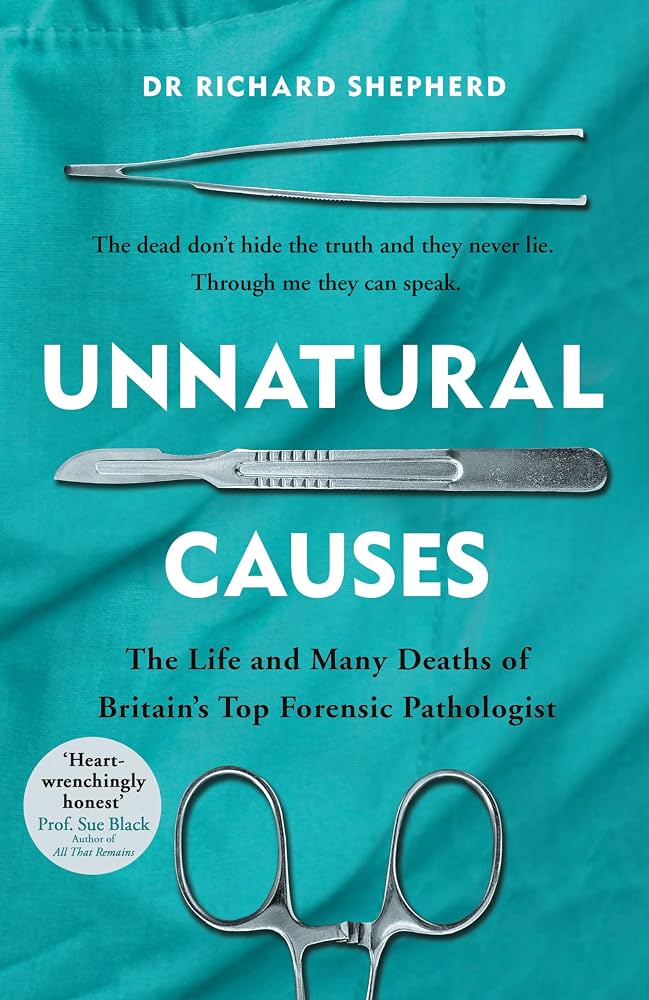
There are few professions that require a person to confront death as directly and consistently as forensic pathology. In Unnatural Causes, Dr Richard Shepherd provides a fascinating and often deeply moving account of his career investigating deaths, examining evidence and helping determine how people died.
Shepherd is a renowned British forensic pathologist who has worked on thousands of post-mortem examinations during his career. His memoir offers readers an unusually detailed insight into the realities of forensic medicine and the painstaking process involved in establishing the cause and circumstances of death.
What makes Unnatural Causes particularly compelling is that it does not present forensic pathology as the glamorous science sometimes portrayed in television dramas. Instead, Shepherd explains the importance of methodical examination, medical knowledge, evidence and professional judgement. Determining the truth behind a death can involve far more than identifying an obvious injury. Disease, trauma, toxic substances, environmental factors and the circumstances surrounding a death may all need to be considered.
For anyone interested in true crime and investigative work, this is one of the book’s greatest strengths. Shepherd demonstrates that understanding a case requires patience and attention to detail. The post-mortem examination is not an isolated procedure; its findings can become an important part of a much wider investigation involving police officers, other medical professionals, forensic specialists and the courts.
The book also provides an important reminder that behind every forensic examination is a human being. Shepherd writes about victims and their families with considerable seriousness, while also describing the emotional and psychological demands of working around death throughout an entire career.
Another particularly interesting aspect is Shepherd’s involvement in some major and high-profile cases. His professional experiences provide an insight into how forensic evidence can contribute to investigations and judicial proceedings. However, the book’s real value lies not simply in the famous cases but in the explanation of the profession itself.
From an investigative perspective, Unnatural Causes reinforces an important principle: evidence must be examined objectively, and conclusions should follow the evidence rather than the other way around.
That principle applies far beyond forensic pathology. Whether researching a historical cold case, examining court documents or investigating a contemporary crime, reliable conclusions depend upon distinguishing established facts from assumptions, theories and speculation.
Shepherd’s memoir therefore offers much more than an account of life as a forensic pathologist. It is an exploration of death investigation, evidence, professional responsibility and the search for truth.
For readers interested in true crime, forensic science, criminal investigation or the British justice system, Unnatural Causes is an extremely worthwhile read. It is informative without losing sight of the human stories at its centre, and it provides a valuable perspective on a profession that is essential to understanding how and why people die.
My verdict: Unnatural Causes is a compelling and informative book that provides a rare glimpse into the realities of forensic pathology. For anyone interested in understanding the investigative process behind unexplained and suspicious deaths, I would highly recommend it.









Leave a Reply